Costs
Part of Reading dental social media with a sceptical eye
What actually improves dental social media beyond posting more often?
how to improve dental social media starts with one audience task, a verified brief, controlled production, accessible publishing, moderation, and outcome review.
What to take away
- Choose one patient task, set a four-week baseline, and publish a short series that answers it.
- Three posts a week on two platforms is a workable start for a single-site practice.
- Each post carries a brief with a source, a clinical reviewer, rights, a reply plan and a review date.
- Improved means the task metric moved, not that the post count rose.
Fix the destination before the calendar
A practice that posts more often and sees flat results usually has a fine post and a broken journey. The first-visit reel ends at a profile link that opens a 2019 page.
Check the route first. Open the profile link, the phone number and the booking page on a phone, while signed out, and again outside office hours.
Then answer the patient's question in their own words. "Do you take my insurance?" beats a post about a practice award. Google's guidance on local ranking explains why an accurate, active profile is the part of prominence you control.
Reading dental social media with a sceptical eye is worth ten minutes, because a healthy-looking feed says nothing about whether calls get answered.
Post formats and cadence that fit dentistry
Post formats and cadence
| Patient task | Format | Length | Cadence |
|---|---|---|---|
| First visit nerves | Staff walk-through reel, captioned | 30 to 45 seconds | Weekly for four weeks |
| Accessible entrance | Three photos: street, door, counter | 3 images | Post once, refresh twice a year |
| Cost and insurance | Short text post with a reply plan | Under 100 words | Every two weeks |
| New patient forms | Screen recording of the form | 60 seconds | Monthly |
Pick two rows for a first cycle. Three posts a week is enough for a single-site practice. Two platforms is the ceiling until someone owns replies on both.
The CDC archive of The Health Communicator's Social Media Toolkit still gives a usable sequence for objectives, audiences, roles and evaluation in health communication. Check its platform notes against current features before you copy them.
Scheduling features change without notice. Confirm format limits in the live account, and keep the calendar inside the hours the front desk has, which is where dental marketing strategy development starts.
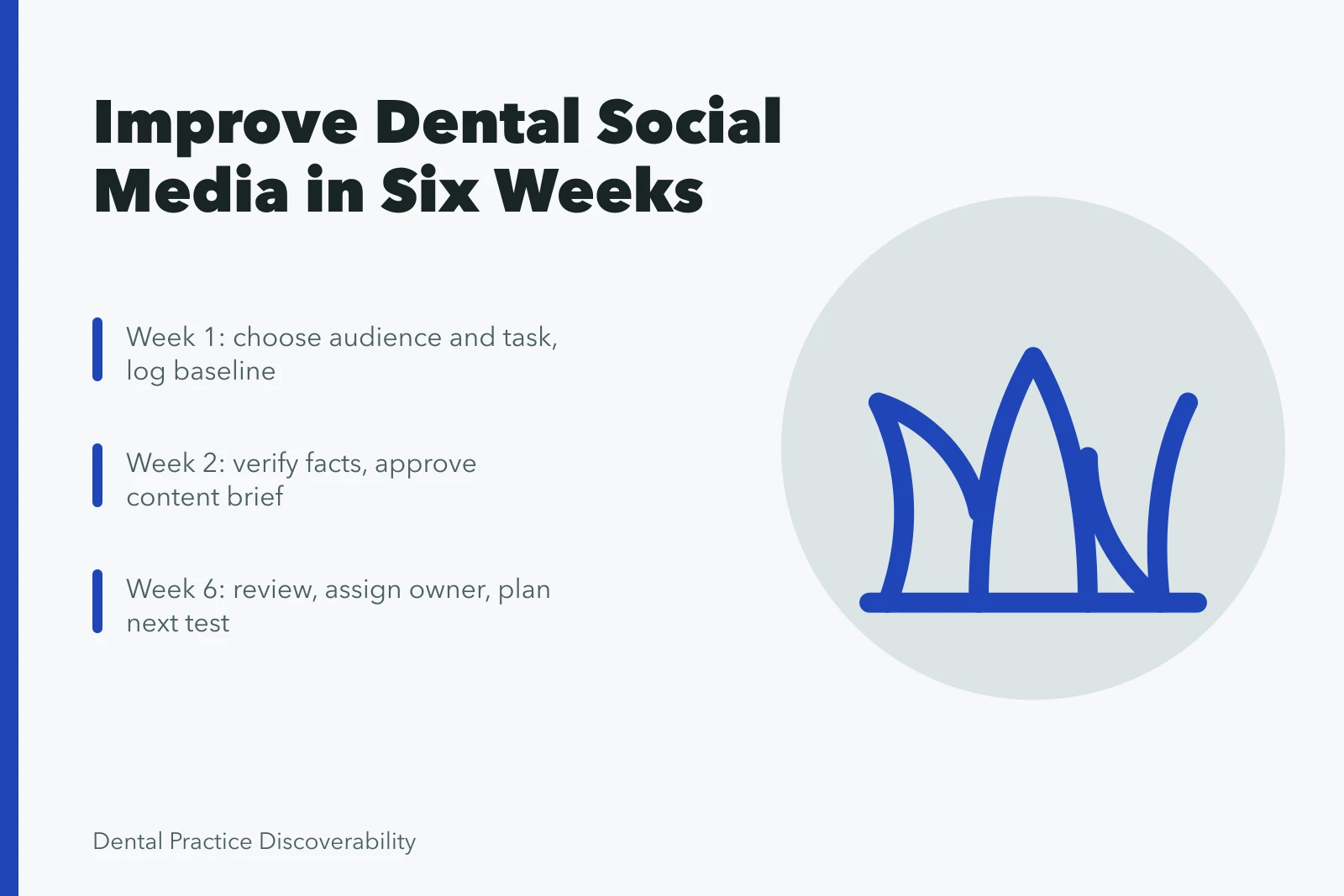
The six-week cycle, week by week
The six-week cycle
| Week | Work | Proof of completion |
|---|---|---|
| 1 | Choose the task, write the patient question, record four weeks of baseline | Baseline sheet with four weekly numbers |
| 2 | Write four briefs and have the clinical reviewer sign sources and rights | Signed brief for each post |
| 3 | Publish post one and moderate replies within one business day | Live link and reply log |
| 4 | Publish post two and test the destination page on a signed-out phone | Mobile test notes |
| 5 | Publish post three and flag the questions that repeat | Reply log with repeats marked |
| 6 | Compare the metric with baseline and write the decision | One-page record and the next review date |
Six-Week Dental Social Media Cycle
- Week 1Choose audience and task
- Week 2Verify facts and risks
- Week 3Produce accessible variants
- Week 4Publish and moderate
- Week 5Check destination behavior
- Week 6Review and revise
Six weeks is a test, not a campaign. If the metric is flat, examine the task choice and the destination page before you rewrite captions.
Channel capacity decides what a practice can sustain, and it is usually smaller than the content calendar suggests.
Example: a verified brief for an accessibility post
Verified brief for an accessibility post
- Patient question"Is there a step-free way in?"
- Sourcethe practice manager walked the route and measured the door width on the walk-through day. The post claims only that measurement.
- Reviewerthe dentist owner checked the wording and dated the approval.
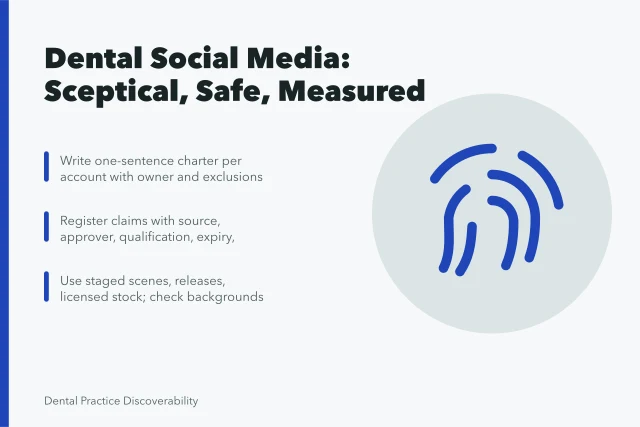
- Rightsphotos taken by a staff member, no patient faces, no licence plates.
- Reply planthe front desk answers within one business day. Anything about one person's mobility goes to the manager, not the comments.
- Review datesix months, or sooner if the entrance changes.
Any stranger should be able to reproduce that post and defend it. Weak briefs resurface later as deleted posts and awkward replies, which is the pattern behind most dental social media questions that keep coming back to the front desk.
Who approves, moderates and escalates
- Clinical claimsthe dentist owner approves and dates the source.
- Publishingthe practice manager owns the calendar and the final check.
- First repliesthe front desk, within one business day, using agreed wording.
- Escalationanything clinical, angry, or about a named person goes to the manager the same day.
Never confirm in a public reply that someone is a patient. Never discuss treatment in a comment thread. The HHS HIPAA Privacy Rule overview covers what a practice may say, so write the front desk script around it.
Keep a reject log for posts held over weak evidence, expired claims, missing releases or an unowned account. Repeated reasons point at the process, not the person.
How to tell whether anything improved
The baseline sheet is the comparison, not last month's feel. Review at week six, then again two weeks later.
A typical range for a single-site practice posting three times a week: a handful of extra profile link clicks and one or two traceable first visits across six weeks. Treat that as a reason to run a second cycle, not as proof of a trend.
It counts as improved when:
- The chosen metric sits above the four-week baseline.
- It holds for two weeks after the series ends.
- The phone gets answered, not just called.
- The reject log gets shorter.
Keep the evidence beside the decision so a new team member can reproduce the reasoning. The same record supports dental marketing strategy best practices when staff change or a vendor rotates.