Costs
Dental marketing costs in Canada, a province-by-province guide in CAD
Dental marketing costs Canada practices pay in CAD, from agency retainers to Google Ads and SEO, plus CRA GST/HST rules for every Canadian province.
What to take away
- Dental marketing costs Canada practices budget for run from about $1,500 to $8,000 a month for agency retainers, plus ad spend of $800 to $6,000 a month, depending on province and market size.
- Ontario and British Columbia carry the highest agency and ad rates; Quebec adds French-language production costs under Bill 96; Alberta and the Prairies sit mid-range; Atlantic Canada and the territories are lower but have thinner provider choice.
- Google Ads cost per click for dental terms typically falls between $4 and $18 CAD, with implant and orthodontic keywords at the top of that range.
- SEO and content retainers in Canada commonly run $1,200 to $5,500 a month, with bilingual work in Quebec adding 15 to 30 percent.
- GST/HST applies to most dental marketing invoices, and a GST/HST-registered practice can generally claim the tax paid as an input tax credit.
- The CRA expects you to keep invoices, contracts and proof of payment for at least six years, and to show how each expense relates to earning dental practice income.
What dental marketing costs include in Canada, in CAD
A dental marketing budget in Canada is rarely one line item. Most practices pay for a strategy or account management fee, production work such as websites and landing pages, paid media management, and the ad spend itself. Some also pay for photography, video, translation and review software.
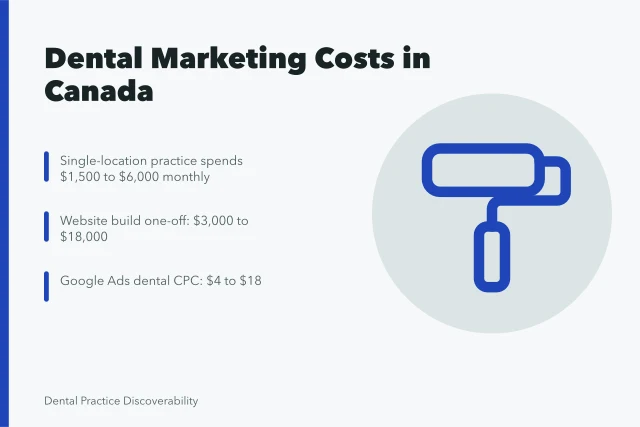
Agency retainers are the largest recurring cost. In Canadian dollars, general dental practices typically pay $1,500 to $4,500 a month for a retainer that covers SEO, content and reporting. Multi-location or specialty practices, such as orthodontics and implant surgery, often pay $4,000 to $8,000 monthly because campaigns need more creative and closer tracking.
Google Ads budgets sit on top of the retainer. A single-location general practice in a mid-sized Canadian city might spend $800 to $2,500 a month on search ads, while implant-focused campaigns in Toronto or Vancouver can exceed $6,000 a month.
Management fees for those campaigns usually run 10 to 20 percent of ad spend, or a flat $500 to $1,500 monthly.
SEO and content pricing varies widely. Entry-level local SEO for one clinic commonly costs $800 to $1,800 a month. A fuller programme with blog content, service pages and link work runs $1,800 to $5,500 a month.
One-off website builds for dental practices in Canada generally fall between $6,000 and $25,000, depending on the number of locations and languages.
Other costs to plan for include photography and video, which can run $2,000 to $10,000 per shoot in major markets, and review management tools at $100 to $400 a month. French translation for Quebec campaigns often adds $0.18 to $0.30 per word.
For a fuller breakdown of what practices actually pay, see cost of dental marketing canada.
Currency matters here. All figures in this guide are in Canadian dollars. US agency quotes should be converted and checked for cross-border billing fees, which can add one to three percent.
Agency retainers by province: Ontario, British Columbia, Quebec and Alberta
Retainer pricing in Canada tracks local wage costs, competition for dental clients and the density of agencies. The table below gives typical monthly retainers in CAD for a single-location general practice, based on common market ranges.
Show the numbers
| Ontario | $2,000–$5,500 |
|---|---|
| British Columbia | $1,800–$5,000 |
| Quebec | $1,700–$4,800 |
| Alberta | $1,500–$4,200 |
| Manitoba and Saskatchewan | $1,200–$3,500 |
| Atlantic Canada | $1,200–$3,200 |
| Yukon, NWT, Nunavut | $1,000–$3,000 |
Ontario practices usually see the widest spread. A Toronto agency with a downtown client list may quote $4,000 to $5,500 a month for a general practice, while agencies in Hamilton, London or Ottawa often sit at $2,000 to $3,500.
The Royal College of Dental Surgeons of Ontario sets advertising rules that agencies must follow, which adds compliance review time to campaigns.
British Columbia retainers are close behind. Vancouver and Victoria agencies price at the upper end, partly because of housing and wage costs. The College of Dental Surgeons of British Columbia requires advertising to be truthful and not misleading, and agencies that understand this tend to charge for the extra review.
Quebec is a special case. Bill 96 and the Office québécois de la langue française require French-language marketing for most consumer-facing materials. That means agencies must produce French versions of websites, ads and landing pages, and many charge 15 to 30 percent more than for English-only work.
A Montreal retainer of $2,500 might be $1,900 for the same scope in English elsewhere.
Alberta retainers are moderate. Calgary and Edmonton have a healthy agency supply, and media costs are lower than in Toronto or Vancouver. A general practice in Red Deer or Lethbridge may pay $1,500 to $2,500 a month, while a Calgary implant clinic could pay $3,500 or more.
When comparing quotes, ask what is included. Some agencies bundle ad management into the retainer, others bill it separately. For a closer look at what a realistic ad budget looks like, see cost of google ads for dentists.
Google Ads budgets and cost per click across Canadian markets
Google Ads pricing in Canada is driven by competition, procedure type and geography. Dental keywords are expensive because a single new patient can be worth thousands of dollars over time, and clinics in large cities bid against each other.
Typical cost per click ranges for dental keywords in Canada:
- General dentistry and check-up terms: $3 to $8 CAD
- Cosmetic dentistry and whitening: $5 to $12 CAD
- Invisalign and clear aligners: $7 to $15 CAD
- Dental implants: $9 to $18 CAD
- Emergency dentist terms: $6 to $14 CAD
These are click costs, not cost per booking. A practice might need 10 to 25 clicks to get one enquiry, and several enquiries to get one booked patient. That is why monthly budgets matter more than click prices alone.
Market differences are real. Toronto, Vancouver and Montreal have the highest click costs because of population density and agency activity. Calgary and Edmonton are usually 10 to 20 percent lower.
Smaller markets such as Halifax, Saskatoon or St. John's may be 20 to 40 percent lower, but search volume is also smaller, so budgets of $800 to $1,500 a month can still reach most local searchers.
In the territories, Google Ads can be efficient because competition is thin. However, low search volume means campaigns need careful keyword selection to avoid spending on irrelevant clicks. A Yellowknife or Whitehorse practice might run a $400 to $900 monthly budget and still appear at the top of local results.
Quebec adds a language dimension. French-language ads may cost less per click than English ones in the same city because fewer advertisers bid on French terms. Running both languages can raise total spend, but it also captures patients who search in French only.
Set a budget you can sustain for at least three months. Google Ads needs time to gather conversion data, and stopping after a few weeks wastes the learning period. Most Canadian dental practices see stable cost per lead after 60 to 90 days.
SEO and content pricing from the Prairies to Atlantic Canada
SEO pricing in Canada reflects the work required to rank in local search, not just the size of the city. A clinic in Winnipeg competes with fewer practices than one in Toronto, but it also has a smaller patient base, so agencies price accordingly.
In Manitoba and Saskatchewan, local SEO retainers commonly run $1,000 to $2,500 a month. That usually covers Google Business Profile management, on-page work, local citations and a few content pieces each quarter. Agencies in Regina and Saskatoon may charge less than Winnipeg firms because of lower overheads.
Alberta SEO pricing sits slightly higher, at $1,200 to $3,500 a month. Calgary and Edmonton have more agencies and more competitive keywords, especially for implants and orthodontics. Practices outside the two big cities often pay $1,000 to $2,000.
Atlantic Canada has fewer dedicated dental SEO providers. Halifax has a handful, and Moncton, Saint John and St. John's have even fewer. Retainers of $1,000 to $2,800 a month are common, and some practices work with agencies in Toronto or Montreal remotely.
Remote work can reduce costs but may miss local nuances such as regional health authority rules.
Northern Canada is the thinnest market. Yukon, Northwest Territories and Nunavut have very few agencies, and most dental practices there either manage SEO in-house or hire remote providers. Retainers of $800 to $2,000 a month are typical, with extra fees for travel if on-site work is needed.
Content marketing is often priced separately. A single blog post written for a dental audience might cost $250 to $800 in Canada, while a full service page with original photography can run $800 to $2,500.
Bilingual content in Quebec doubles the writing cost for French versions. For help choosing a provider that will not overpromise, see our guides to hipaa compliant dental marketing and common dental marketing strategy questions.
One more cost to note: compliance. Canadian marketing must respect the Personal Information Protection and Electronic Documents Act (PIPEDA), the Canadian Anti-Spam Legislation (CASL), and provincial health privacy laws such as PHIPA in Ontario and PIPA in Alberta. Agencies that build consent into forms and email tools may charge more, but they reduce legal risk.
GST/HST treatment of dental marketing expenses under CRA rules
Dental marketing services supplied in Canada are generally subject to GST/HST. The rate depends on the province where the service is supplied, and the Canada Revenue Agency (CRA) sets the rules for registration, collection and input tax credits. The CRA's GST/HST for businesses page covers the framework.
If your dental practice is registered for GST/HST, you can usually claim the GST/HST you pay on marketing invoices as an input tax credit. That means the tax is not a final cost, provided you meet the conditions.
You must have a valid invoice and the expense must relate to your commercial activity. Most dental services are exempt from GST/HST, which can affect how much input tax credit you can claim.
Rates vary by province. Ontario charges 13 percent HST, and the Ontario government publishes HST guidance on what the tax applies to. British Columbia has 5 percent GST plus 7 percent provincial sales tax on some services, but marketing services are generally GST only.
Quebec has 5 percent GST plus 9.975 percent Quebec sales tax. Alberta and the territories have 5 percent GST only. The remaining provinces combine GST or HST with their own sales taxes, at combined rates of 13 to 15 percent.
For a dental practice, the practical effect is this: a $3,000 monthly retainer in Ontario comes with $390 in HST, making the invoice $3,390. If you are GST/HST-registered and can claim the input tax credit, the net cost is $3,000. If you are not registered, the $390 is a real cost.
Advertising and marketing expenses are generally deductible for business income tax purposes if they are incurred to earn income. The CRA's guidance on business expenses explains the general rules.
However, some advertising costs may be capital in nature, such as a new website that provides lasting benefit. In that case, the cost may need to be depreciated over time rather than deducted in one year. Accountants often treat website builds this way.
Agency invoices should show the GST/HST registration number, the amount of tax, and the total. If an agency is not registered, it should not charge GST/HST, but you should confirm the registration status. The CRA's taxes hub is a useful starting point for rate and filing questions.
Documenting dental marketing spend for CRA record-keeping
The CRA requires businesses to keep records that support their tax returns and input tax credit claims. For dental marketing, that means keeping invoices, contracts, proof of payment and any documentation that shows what was delivered.
Records must generally be kept for at least six years from the end of the last tax year they relate to. The CRA's keeping records guidance sets out what counts as adequate. Digital copies are acceptable if they are legible and secure.
Here is a simple process to keep marketing records in order:
- Save every agency invoice as a PDF, including the GST/HST breakdown and registration number.
- Record the payment date and method in your accounting software, linking it to the invoice.
- File the contract or statement of work that describes the services, such as SEO, ads or content.
- Keep monthly reports that show what was delivered, such as ad spend summaries or ranking reports.
- Store everything in one folder per year, with subfolders for each agency or platform.
- Review the folder before filing your GST/HST return and income tax return.
A checklist for each marketing expense:
- Invoice shows the supplier's GST/HST number.
- Invoice states the amount of GST/HST charged.
- Payment is traceable to a bank or credit card statement.
- Contract or scope of work is on file.
- Reports or deliverables show the service was provided.
- Expense is recorded in the correct tax year.
If you claim input tax credits, the CRA may ask for the invoices and proof of payment. Missing documents can lead to denied credits and reassessment. Keeping records digitally and backing them up reduces that risk.
For practices using ad platforms, keep the platform invoices too. Google Ads and Meta bill separately from agency fees, and those invoices also carry GST/HST. They are part of your marketing spend and should be recorded the same way.
Building a province-by-province dental marketing budget
A budget that works in Ontario may be too high for Atlantic Canada or too low for a Vancouver implant clinic. Build yours from the ground up using local costs and your patient goals.
Start with your target. How many new patients do you need each month? If your average patient value is $800 in the first year, and you need 20 new patients, you need $16,000 in first-year revenue. Marketing should be a fraction of that, often 5 to 10 percent.
Next, allocate across channels. A common split for a Canadian general practice is 40 to 50 percent to Google Ads, 30 to 40 percent to SEO and content, and 10 to 20 percent to website and creative work. Specialty practices may shift more to ads for immediate enquiries.
Then adjust for province. Use the ranges in this guide and get at least three quotes from agencies that work in your province. Ask about compliance with provincial dental college advertising rules, PIPEDA, CASL and, in Quebec, Bill 96. Those requirements affect cost.
Set aside a contingency of 10 percent. Ad costs can rise during competitive periods, and translation or creative revisions may add costs. Review your budget quarterly and shift spend toward what brings booked patients, not just clicks.
Finally, track cost per new patient, not cost per click. That is the number that tells you whether your dental marketing budget is working. For a broader planning framework, see dental practice marketing budget.
Common questions
Do I need to charge GST/HST on dental marketing if I am not registered? If your practice is not registered for GST/HST, you do not charge it on your dental services. However, you also cannot claim input tax credits on marketing invoices, so the GST/HST you pay becomes a real cost.
Are dental marketing costs tax deductible in Canada? Generally yes, if they are incurred to earn business income. Advertising and promotion are common deductible expenses. Some costs, such as a new website with lasting value, may need to be capitalised and depreciated. Check with your accountant.
How long should I keep marketing invoices for the CRA? At least six years from the end of the last tax year they relate to. Digital copies are acceptable if they are legible and secure. The CRA may ask for them when reviewing input tax credit claims.
Does Bill 96 affect dental marketing costs in Quebec? Yes. French-language requirements mean websites, ads and patient materials often need French versions. Agencies charge for translation and bilingual review, which can add 15 to 30 percent to a Quebec retainer.
What is a realistic monthly Google Ads budget for a Canadian dental practice? For a single-location general practice, $800 to $2,500 a month is common. Implant or orthodontic campaigns in large cities can exceed $6,000. Start with a budget you can sustain for at least three months.
Can I claim input tax credits on agency fees? If you are GST/HST-registered and the agency charged GST/HST on a valid invoice for services used in your commercial activity, you can generally claim the tax as an input tax credit. Keep the invoice and proof of payment.