Rules
Part of Dental SEO: signal versus noise, updated for 2027
How to use dental SEO benchmarks in planning
dental SEO benchmarks for 2027 should compare matched search tasks, pages, locations, devices, technical health, qualified inquiries, attendance, and data coverage.
What to take away
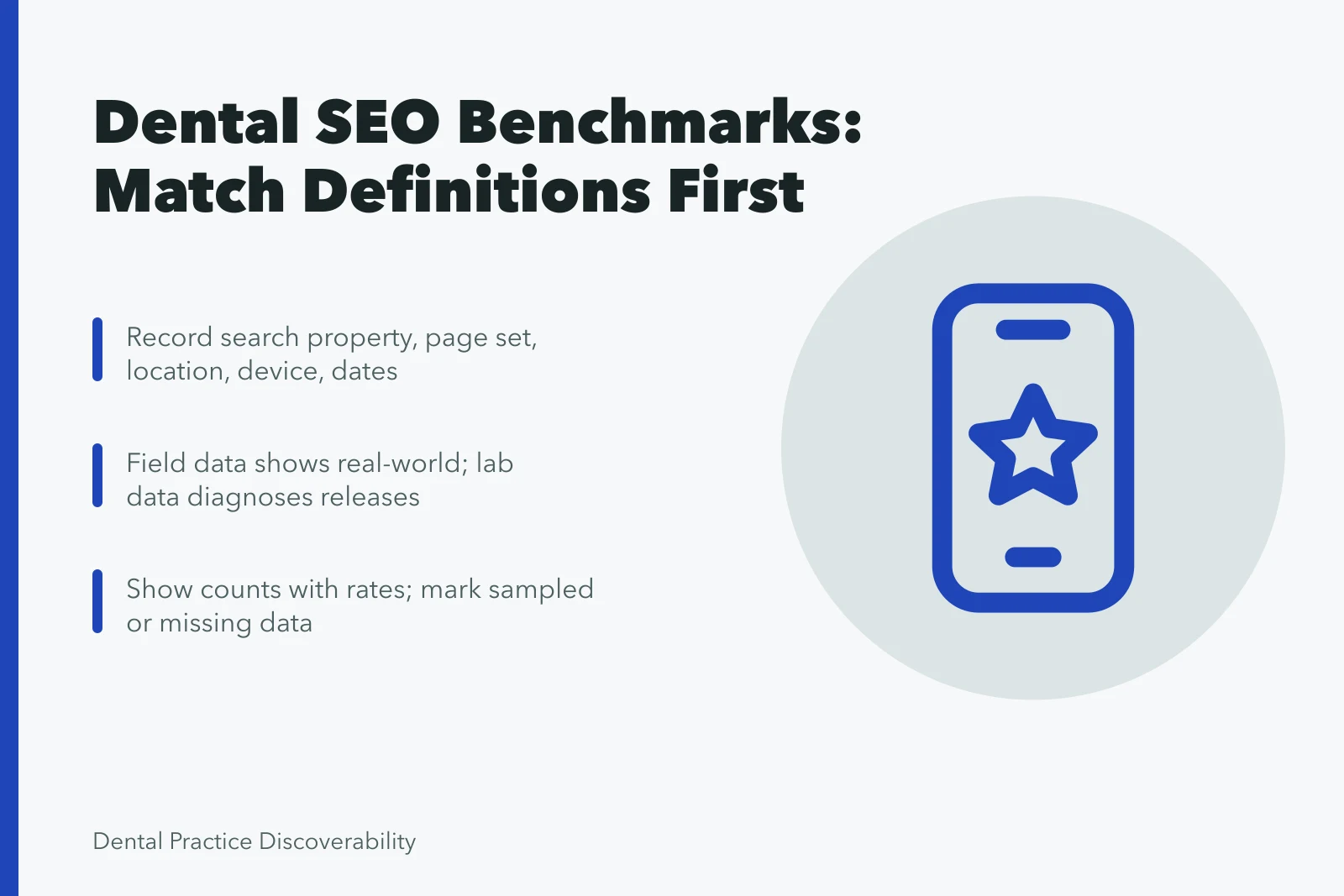
- Use benchmarks with the same metric, page set, device, and time window.
- Field and laboratory performance data answer different questions.
- Search traffic must be reconciled with suitable patient outcomes.
Dental SEO benchmarks are meaningful only when the definitions match. Work through these steps before any comparison.
- Fix the metric. Choose one measure, such as impressions, clicks, click-through rate, or booked inquiries.
- Fix the page set. List the URLs or templates in scope before you export anything.
- Fix the device and location. Report mobile and desktop, and each office, as separate rows.
- Fix the time window. Use the same dates on both sides and name the season or campaign.
- Record the inclusion rules, calculation, currency, maturity window, uncertainty, and data coverage.
A national agency average cannot replace a practice baseline with known facts.
Build a layered benchmark card
| Layer | Measure | Source | Comparison |
|---|---|---|---|
| Technical | Important pages returning expected status | Crawl tool and uptime monitor | Pre-release or prior stable period |
| Indexing | Preferred pages indexed | Search Console Pages report | Same page class |
| Visibility | Impressions by task and location | Search Console Performance report and Google Business Profile | Matched season and scope |
| Use | Search clicks and completed page tasks | Search Console and GA4 | Same device mix |
| Access | Suitable inquiries and attendance | Call tracking and practice management booking data | Mature cohort |
| Quality | Errors, complaints, and data coverage | Practice management system, call notes, and GA4 | Fixed definitions |
A worked card with illustrative numbers, not a published average. One implant landing page, mobile, same URL, two six-month windows.
Prior six months
- Impressions
- 9,800
- Clicks
- 490
- Click-through rate
- 5.0 percent
- Inquiries booked
- 25
This six months
- Impressions
- 12,400
- Clicks
- 620
- Click-through rate
- 5.0 percent
- Inquiries booked
- 38
The rate held at 5.0 percent, so the extra 130 clicks track the extra 2,600 impressions. Inquiries rose by 13.
Read field performance in context
The Search Console Core Web Vitals report groups URLs using real-world usage data and evaluates defined experience measures. A report status is a technical signal. It does not by itself measure accessibility, comprehension, appointment completion, or clinical quality.
Diagnose a release with lab tests
Google's explanation of PageSpeed Insights distinguishes field data from controlled laboratory data and notes that lab results may not capture real-world bottlenecks. Use repeatable lab tests to investigate a release, then monitor field experience where enough data exists.
Counts With Rates
Scenario
- Small sample
- 10
- Large sample
- 1,000
Clicks
- Small sample
- 20
- Large sample
- 2,000
Impressions
- Small sample
- 50%
- Large sample
- 50%
Rate
- Small sample
- Large sample
Show counts with rates. Mark anonymized, sampled, missing, delayed, or unmatched data near the conclusion.
Use a prior stable period, a matched page group, or a controlled rollout. Avoid declaring improvement from one favorable week. Search demand, holidays, news, weather, capacity, and competitive changes can alter outcomes. State alternative explanations.
Do not average away a failing patient path. Segment important pages by location, service, device, and task, then inspect the cases behind a change. One fast high-traffic page can conceal a slow booking route. One busy location can conceal another office with wrong hours or no available appointments.
Reproduce the comparison
The GAO evaluation design guide connects evaluation questions with evidence needs and design choices. The NIST experimental design selection guidance begins design choice with the objective and practical constraints.
Keep market context separate from an internal target. Recalculate the figure from the cited source or governed dataset, then record any mismatch. A benchmark becomes useful only after the local team explains why the comparison group and method fit the decision.
For dental SEO benchmarks, keep the evidence record beside the decision so a reviewer can reproduce the reasoning without relying on memory. Set the next review date for dental SEO benchmarks, and name the change that would trigger an earlier check.
Record rejected options and the chosen path because the original constraint may change later. Use the same definitions in the interface, export, meeting note, and correction log. Close unused reports and permissions after the decision cycle ends.
Common questions
What is a good dental SEO click-through rate?
There is no universal rate. Position, query intent, page type, device, and search appearance change the rate more than the site does. Compare the same query class, page, device, location, search appearance, and period with counts shown.
Should every page meet one speed number?
Core Web Vitals field thresholds are 2.5 seconds for largest contentful paint, 200 milliseconds for interaction to next paint, and 0.1 for cumulative layout shift, all at the 75th percentile. Use current field thresholds and task evidence, while accounting for page purpose, data availability, and diagnostic limits.
Which benchmark matters most?
No single metric ranks above the rest, because the decision sets the order. The one tied to the current decision, often accurate task completion and attended suitable care rather than a ranking.