Guides
From honest discovery to a measured ledger: dental patient acquisition done right
dental patient acquisition in 2027 connects honest discovery, usable scheduling, trained response, respectful intake, attended visits, capacity, and measured cost.
What to take away
- Define acquisition as an attended, suitable first visit, not a click or raw lead.
- Build the journey backward from clinical and operational capacity.
- Measure every handoff from discovery through attendance without exposing patient information.
- Stop or narrow campaigns when demand, trust, privacy, or service quality deteriorates.
Dental patient acquisition is the controlled process that helps an appropriate prospective patient discover a practice, understand a relevant service, make contact, schedule, complete intake, and attend a first visit. That definition is deliberately stricter than traffic, calls, forms, or appointments.
A dependable program protects patient choice and practice capacity at the same time. It gives people accurate information without diagnosing them through marketing, makes the next step easy, and hands sensitive discussion to trained staff. It also shows leaders which sources produced suitable attended demand and what the full journey cost.
Set an outcome the practice can own
Choose one primary acquisition outcome before selecting channels. A useful default is a completed first visit for a person who sought a service the practice can appropriately assess. Define the service area, age or access limits, benefit participation, language support, appointment window, exclusions, and maturation period. Record how reschedules, emergencies, duplicates, existing patients, and referrals are classified.
Acquisition stages and owners
- Discovery: accurate listing shown, Marketing
- Contact: real patient reached, Front office
- Fit: request belongs in workflow, Trained staff
- Schedule: valid first appointment accepted, Scheduler
- Intake: administrative steps completed, Operations
- Attendance: patient arrived, Practice manager
| Stage | Qualified event | Owner |
|---|---|---|
| Discovery | Accurate listing or message was shown | Marketing |
| Contact | A real prospective patient reached the practice | Front office |
| Fit | The request belongs in the practice workflow | Trained staff |
| Schedule | A valid first appointment was accepted | Scheduler |
| Intake | Required administrative steps were completed | Operations |
| Attendance | The patient arrived for the first visit | Practice manager |
Start with capacity and access
Count the first-visit slots the practice can reliably provide by location, clinician, service, language, and time of day. Subtract blocked time, expected urgent work, staffing constraints, and realistic follow-up needs. Acquisition should fill usable capacity, not create a queue the practice cannot serve.
Access checks before demand
- Parking or transit information
- Entrance details
- Communication accommodations
- Language routes
- Phone coverage
- Form usability
- Financial information and after-hours plan
Review physical and digital access before adding demand. Confirm parking or transit information, entrance details, communication accommodations, language routes, phone coverage, form usability, financial information, and what happens outside business hours. Never advertise immediate access when the scheduling system cannot deliver it.
Describe the patient and need without stereotyping
Build an audience brief around a legitimate service need and geography. Separate facts from assumptions. Age, neighborhood, insurance status, disability, language, household structure, and browsing behavior can carry legal, ethical, or platform restrictions. Do not infer a diagnosis or private condition merely because a targeting tool makes the option available.
Audience brief elements
- Service and location the practice supports
- Question the patient is answering
- Information needed before contact
- Barrier that may prevent scheduling
- Safe handoff for urgent concerns
- Signals request belongs elsewhere
- Capacity limit and pause rule
- Service and location the practice can support
- Question the prospective patient is trying to answer
- Information needed before contact
- Barrier that may prevent scheduling or attendance
- Safe handoff for urgent or sensitive concerns
- Signals that the request belongs elsewhere
- Capacity limit and pause rule
Create a truthful discovery layer
Every public touchpoint should agree on the practice name, clinician credentials, address, hours, services, accessibility, benefit information, price scope, and contact route. Correct directory records before buying attention. Use claims that the practice can support in the target jurisdiction and review the whole impression created by text, images, offers, reviews, and the destination.
The American Dental Association's page on attracting new patients to a dental practice recommends clear website information about the team, services, financing, and location, along with a welcoming experience and community involvement. Treat these as practice-management ideas, not a promise that any tactic will produce a particular volume or clinical result.
Give each channel a distinct job. A directory may confirm facts, search content may answer a question, an advertisement may introduce a bounded offer, and a referral program may remind established patients that the practice welcomes appropriate introductions. Do not publish the same generic message everywhere and call that a strategy.
A Google Business Profile update carries current hours and services, a recall text reaches patients who are past due, and one page answers a single urgent question. Give each channel its own owner and its own success measure.
Design the contact route as a service
Test calls, forms, texts, chat, and booking routes as a prospective patient would. State response hours and what the channel is for. Ask only for the minimum public information needed to route the request.
Move health history, symptoms, records, images, and payment data into a process that follows HIPAA, the federal rule covering protected health information and the business associate agreements that bind vendors.
Outreach follows other US rules. The Telephone Consumer Protection Act governs marketing calls and texts to cell phones and requires prior express consent, with written consent for most automated marketing texts. State dental boards set the advertising, recordkeeping, and supervision rules a practice must meet, and many state laws add requirements on top of HIPAA.
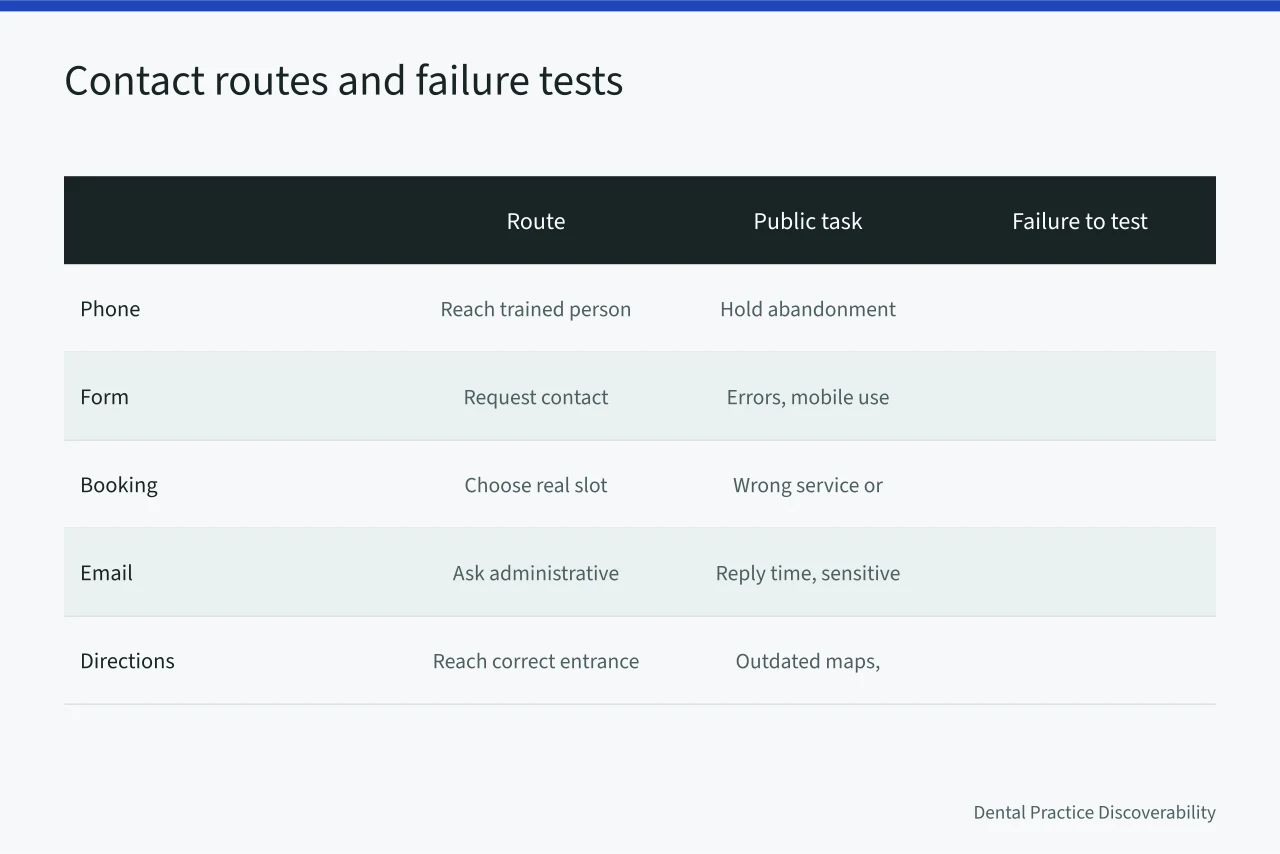
| Route | Public task | Failure to test |
|---|---|---|
| Phone | Reach a trained person or clear callback path | Hold abandonment and missed calls |
| Form | Request contact with minimal fields | Errors, mobile use, and confirmation |
| Booking | Choose a genuinely available slot | Wrong service or location |
| Ask a nonurgent administrative question | Reply time and sensitive content | |
| Directions | Reach the correct entrance | Outdated maps and access barriers |
Train the first human response
The front office needs a short, natural framework rather than a sales script. Staff should identify the requested service, explain the next administrative step, state material availability and payment facts, avoid clinical promises, recognize urgent concerns, and document the source consistently. Listening matters more than forcing a booking.
Audit missed calls and incomplete forms daily during a campaign. Return contacts within the stated window. If volume exceeds coverage, reduce promotion before service quality collapses. A marketing team should never celebrate extra leads while staff face an unmanaged backlog.
Make scheduling easy to understand
Offer real appointment choices and say what the first visit includes without guaranteeing treatment. Explain deposits, cancellation terms, benefit verification limits, records requests, interpreters, guardianship requirements, and accessibility arrangements before the patient commits when those facts are material. Provide a human alternative to self-service booking.
Use reminders that fit the person's chosen channel and current permission. Make confirmation, cancellation, or rescheduling easy.
Track why appointments move without judging character. Transportation, work, caregiving, anxiety, cost, and access barriers call for different responses. Permission and channel choice shape dental email marketing; lists must be lawful and preferences easy to change.
Connect acquisition to the first visit
The public promise must survive the handoff. The reception experience, wait, paperwork, communication, financial discussion, and clinical assessment should not contradict what brought the person in. Marketing cannot decide suitability or treatment. A responsible clinician and patient make those decisions through the proper process.
Ask new patients how they found the practice using a short, neutral question. Preserve their wording and allow unknown. Do not force staff to select the campaign they believe deserves credit. Reconcile self-report with channel records later and show disagreements instead of silently overwriting them.
Measure a complete acquisition ledger
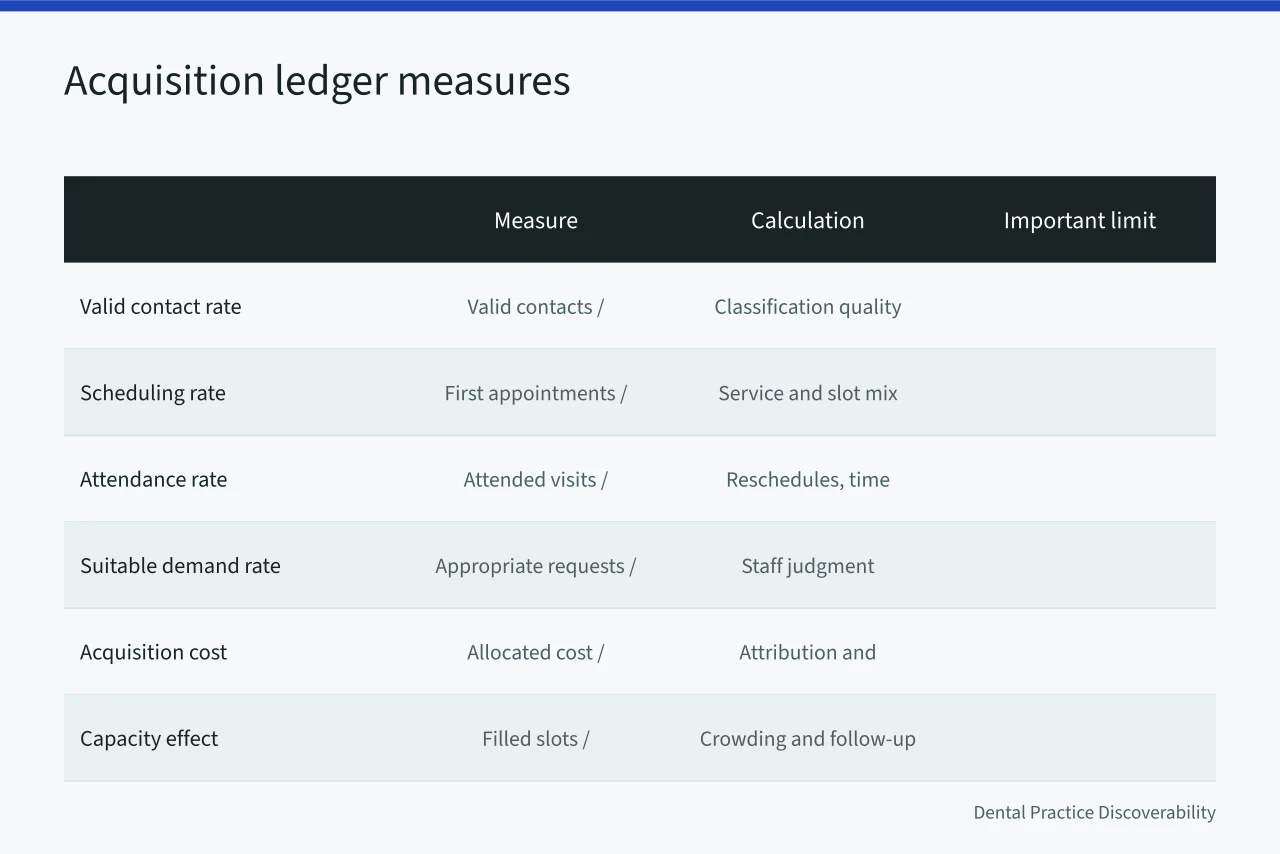
| Measure | Calculation | Important limit |
|---|---|---|
| Valid contact rate | Valid prospective contacts / unique responses | Classification quality |
| Scheduling rate | First appointments / valid contacts | Service and slot mix |
| Attendance rate | Attended first visits / mature appointments | Reschedules and time window |
| Suitable demand rate | Appropriate requests / valid contacts | Staff judgment consistency |
| Acquisition cost | Allocated program cost / attended new patients | Attribution and overhead |
| Capacity effect | Filled usable slots / available first-visit slots | Crowding and follow-up needs |
Report counts beside rates, include media, creative, vendor, software, call costs under a stated method. Add staff, discount, implementation costs.
Keep unattributed patients and missing source answers visible, cost and outcome reporting belongs in a dental marketing strategy that ties spending to measured first visits. Compare like services, matched periods; seasonal demand, staffing, pricing, benefits, and local events can change the result.
A worked example makes this concrete. Paid search, a Google Business Profile update, and a recall text bring 120 valid contacts in one month. Staff accept 60 first appointments. After the maturation window, 42 patients attend.
Allocated program cost is $9,000, covering media, software, call handling, and staff time. Cost per attended first visit is $9,000 divided by 42, or about $214. A scheduling rate of 50 percent and an attendance rate of 70 percent sit beside those counts.
Check that number against the economics before scaling. Compare it with the margin on the first visit plus the treatment the patient is likely to accept over the following year. Reported dental cost per new patient figures vary widely.
General dentistry commonly sits in the low hundreds of dollars per new patient, and competitive markets or specialty care run higher. Treat any such range as a starting point, not a target. If cost per attended visit rises above the value the practice can defend, narrow the channel, repair the offer, or pause.
Use tests that answer one question
Write a hypothesis tied to a mature outcome, such as whether clearer appointment availability increases suitable scheduled contacts without increasing cancellations. Change one meaningful element where possible, preserve both versions, cap exposure, and wait through the maturation window. A higher click rate alone cannot prove better acquisition.
Set stop rules for unsupported claims, wrong locations, broken routes, privacy concerns, excessive response time, unsuitable demand, schedule congestion, complaints, and rising acquisition cost. Assign one person who can pause every channel. Automated optimization never replaces that authority.
Review vendors and data boundaries
Control domains, listings, phone numbers, ad accounts, and analytics. Control billing, creative, and raw exports, map every data transfer, role, retention period, and deletion route, and use fictional records in demonstrations.
A vendor should not receive patient data just because it offers an attractive acquisition dashboard. Owning your ad accounts and raw exports matters, but dental advertising in 2027 demands supported claims and controlled audiences.
At contract exit, revoke access, move owned assets, remove tags and forwarding, recover records, document deletion duties, and test that public routes still work. Avoid arrangements that make the practice pay to recover its own number, listing, history, or audience data.
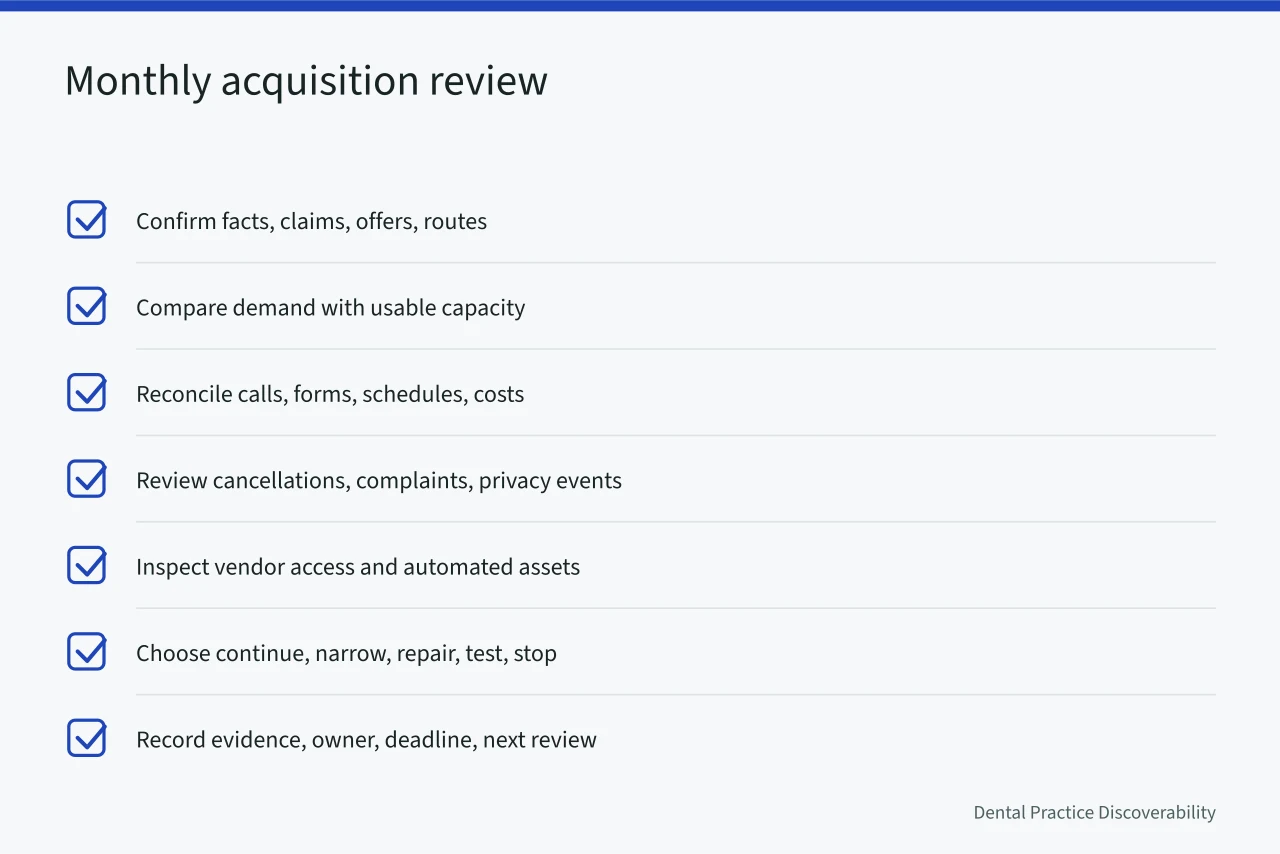
Run a monthly acquisition review
- Confirm facts, claims, offers, locations, and public routes
- Compare demand with usable first-visit and follow-up capacity
- Reconcile calls, forms, schedules, attendance, and costs
- Review cancellations, complaints, privacy events, and access barriers
- Inspect vendor access, platform changes, and automated assets
- Choose continue, narrow, repair, test, or stop
- Record the evidence, owner, deadline, and next review date
The strongest program is not the one with the most leads. It is the one the practice can explain, measure, and operate without compromising trust.
Check the method, privacy rules, and technology choice
For dental patient acquisition, the GAO evaluation design guide explains how evaluation questions, evidence needs, and design choices fit together. The guide is written for federal program evaluation. Use its design discipline as a check on the method, not as proof that a marketing result is causal or transferable.
The W3C Privacy Principles statement gives system designers a shared vocabulary for privacy and warns against shifting privacy work onto individuals. Apply that principle to the data flow behind dental patient acquisition. It does not replace the law, contract terms, consent analysis, or a review of the actual configuration.
The GOV.UK technology selection guidance recommends choices that can change over time, preserve data control, address security risk, and include ownership cost. Those public-service rules become useful buying questions for dental patient acquisition, but they are not private-sector mandates or product endorsements.
Record the tested data, roles, product versions, exceptions, and approval date. Repeat the review after a material source, model, access, contract, or decision change. None of these three sources certifies the local setup or supplies a guaranteed marketing result.
Common questions
What counts as a new dental patient acquisition?
Use a written operational definition. An attended first visit after a suitable inquiry is more reliable than a click, call, form, or unverified booking.
How much should a practice spend to acquire a patient?
There is no universal number. Use full local costs, mature attended outcomes, service economics, capacity, attribution limits, and an approved stop threshold.
Should marketing staff qualify clinical suitability?
No. Staff may route administrative requests under approved guidance, but diagnosis, treatment suitability, and clinical advice belong in the proper professional process.
When should acquisition promotion pause?
Pause when claims lose support, routes fail, demand exceeds capacity, response slows materially, privacy or safety is threatened, unsuitable inquiries rise, or economics exceed the approved limit.
In this guide
- Which signals tell you a dental inquiry will actually turn into a visit?common dental patient acquisition questions cover targets, calls, scheduling, referrals, privacy, attribution, capacity, costs, ownership, and safe qualification.
- How to improve dental patient acquisition for business teams: the parts worth your timehow to improve dental patient acquisition starts by tracing one mature journey, repairing its weakest handoff, testing a bounded change, and protecting capacity.
- Lessons hiding in the dental patient acquisition examplesdental patient acquisition examples show distinct journeys for local discovery, referrals, benefits, urgent requests, access needs, and first-visit follow-through.
- Patient acquisition mistakes for dental practices often start with manipulative designdental patient acquisition mistakes include counting clicks as patients, hiding terms, buying excess demand, weak call handling, unsafe forms, and false certainty.
- Dental patient acquisition checklist: the items people skipdental patient acquisition checklist covers capacity, audience, claims, listings, contact routes, scheduling, privacy, accessibility, measurement, and stop rules.
- How to build dental patient acquisition benchmarks from your own dataA framework for dental patient acquisition benchmarks: nine definition fields, a contact to attended visit rate ladder, and guardrails that keep targets honest.
- Dental patient acquisition tools worth paying for, and the rest (2027 update)Dental patient acquisition tools for 2027 reviewed on ownership, exports, call tracking and cost to a Canadian practice, plus which paid extras are worth it.
- Dental patient acquisition best practices: intake handoffDental patient acquisition best practices at the intake handoff: minimal forms, labeled fields, prompt replies, staff routing, owners, and monthly review.
- Vetting dental patient acquisition case studies from vendorsVetting dental patient acquisition case studies from vendors: the figures they leave out, what to request in writing, and the review privacy limits to respect.
- 4 plain facts about dental patient acquisition trendsdental patient acquisition trends in 2027 include access-first design, workforce limits, source fragmentation, data control, self-service, and mature metrics.