Operations
Part of Dental SEO: signal versus noise, updated for 2027
3 things to understand about dental SEO best practices
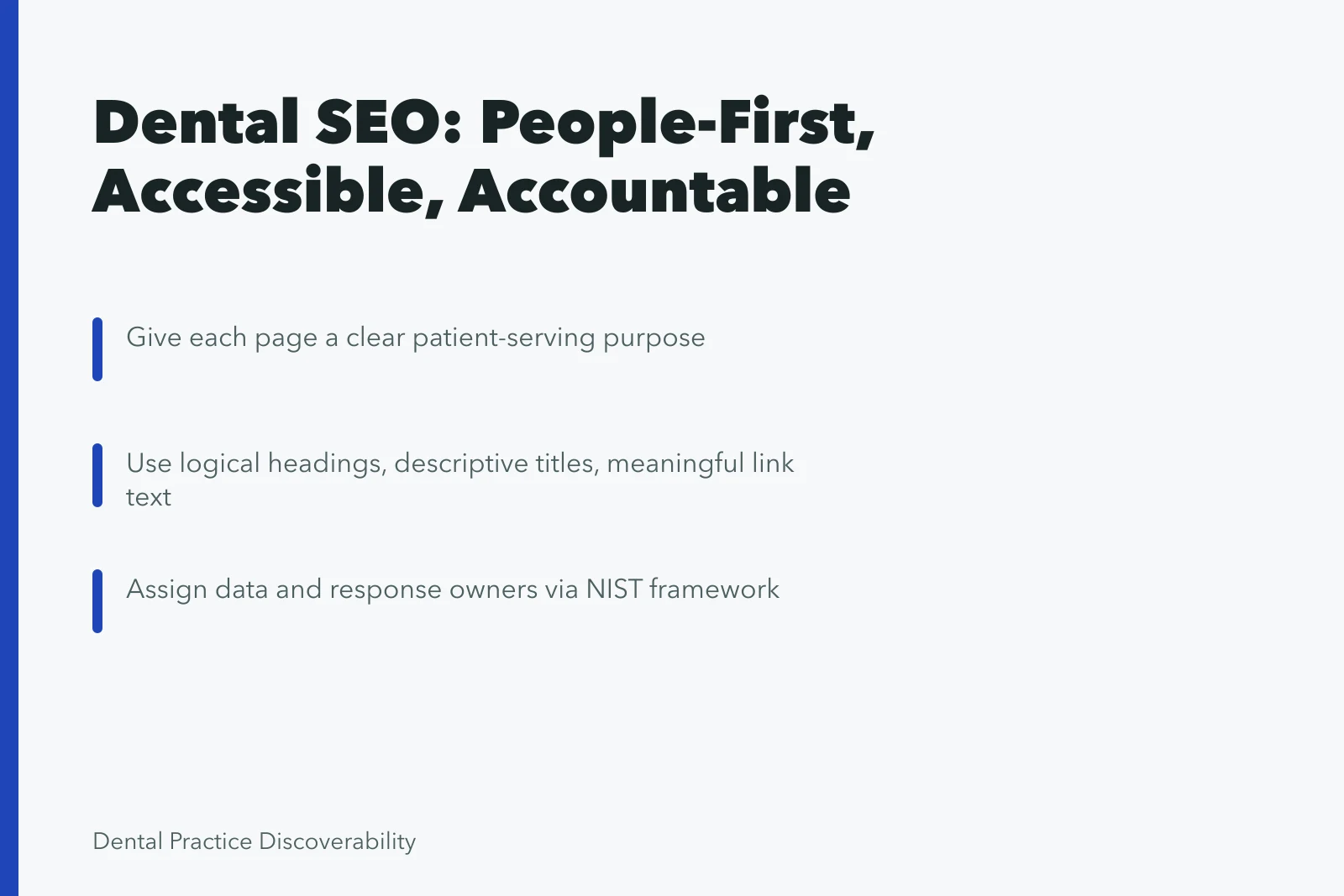
dental SEO best practices align useful patient content, accurate facts, accessible structure, secure technical delivery, governed profiles, and reconciled outcomes.
What to take away
- Give every page one primary search phrase, and place it in the title tag, the H1 and the opening paragraph.
- Complete your Google Business Profile, then keep the practice name, address, phone and hours identical everywhere.
- Add LocalBusiness schema with the Dentist type, and keep mobile Largest Contentful Paint under 2.5 seconds.
- Track impressions, calls, direction requests, form completions and booked appointments monthly.
- Treat clinical accuracy and patient privacy as part of the SEO job.
Dental SEO is a set of publishing habits, not a one-off project. Before you rewrite a page, the dental SEO primer on this site explains which signals still move local rankings and which ones stopped mattering.
The practices that carry the most weight
Seven practices do most of the work. None of them need a large budget.
People-First Content Checks
- Clear purposepatient task and owner
- Accurate factssource and review date
- Clinical integrityqualified content approval
- Accessible structuremanual task test
- Technical accessrendered and indexed sample
- Local governanceowned profiles and audit log
- Outcome reviewreconciled mature cohort
| Practice | Evidence behind it |
|---|---|
| One primary phrase per page | Shows which query each URL already earns, so two pages stop chasing one term |
| Descriptive title and H1 | Titles that echo the query wording earn more clicks at the same position |
| Verified Google Business Profile | Completeness and category choice feed map pack relevance |
| Consistent name, address, phone, hours | Mismatched details split local signals and confuse patients |
| LocalBusiness schema | Markup connects the page to a real practice entity |
| Compressed images | Smaller files hold mobile Largest Contentful Paint under 2.5 seconds |
| Replies to reviews | Fresh review activity feeds prominence in local results |
Start with titles, headings and meta descriptions
The title tag is the strongest on-page element you control. Put the treatment first, the city second, the practice name last. Keep it near 60 characters so Google shows it in full.
The H1 should match the title's promise without repeating it word for word. Search engines read heading order as an outline, so one H2 per topic beats six decorative ones.
Meta descriptions do not rank pages. They set the click expectation. Use 150 to 160 characters to name the treatment, the city and one reason to choose you.
If you want to know whether a meta tag changes how a dental result appears, this site answers that in its piece on common dental SEO questions.
Example: an emergency dentistry page in Austin
Here is how the pieces line up for one page.
Emergency dentistry page in Austin
- Title tag
- Emergency Dentist in Austin, TX - Same-Day Appointments
- H1
- Emergency Dentist in Austin, Texas
- First H2
- What counts as a dental emergency
- Second H2
- Same-day and walk-in appointments
- Link text
- same-day emergency dentist in Austin
- Meta description
- Knocked-out tooth or sudden swelling? Call our Austin office for same-day care.
A reader should know what to do in the first ten minutes without scrolling.
Local SEO: Google Business Profile and consistent practice details
Local SEO: Google Business Profile
- Claim the profile and finish verification by phone, postcard or video.
- Set the primary category to Dentist, then add secondary categories such as Emergency Dental Service or Cosmetic Dentist.
- Fill in services, hours, holiday hours, the address or service area, and ten photos.
- Ask for reviews by text after treatment, and reply to each one.
Google's guidelines for representing your business explain how categories and business details shape what searchers see.
The local ranking documentation names relevance, distance and prominence as the factors behind map results. Prominence is the one a practice can influence.
Keep the name, address and phone identical on the site, the profile, insurance directories and local citations. A phone number written two ways weakens the match.
Review replies need care. Do not confirm that someone is a patient, because that can breach the HIPAA Privacy Rule, which the HHS overview sets out.
Technical SEO: schema markup and mobile speed
Markup does not create rankings by itself. It helps a search engine read what the page is.
Use JSON-LD for LocalBusiness with the Dentist type, plus address, telephone, geo coordinates and openingHoursSpecification. Do not mark up your own testimonials as reviews, since Google's review snippet rules exclude self-serving reviews.
The dental SEO checklist on this site lists the technical items audits tend to miss, including redirect chains and thin service pages.
Compress images to WebP, set width and height on every image, and lazy-load below the fold. Aim for mobile Largest Contentful Paint under 2.5 seconds and Interaction to Next Paint under 200 milliseconds.
Submit an XML sitemap in Google Search Console and keep one canonical URL per page. A service-area page for every suburb usually duplicates the rest and competes for the same query.
Metrics worth naming, and how often to read them
Metrics worth naming
- MonthlySearch Console impressions, clicks and average position for your five target phrases.
- MonthlyGoogle Business Profile calls, direction requests, website clicks and messages.
- Monthlyform completions and booked appointments from the practice management system.
- Quarterlycost per booked appointment if you run Google Ads or Meta ads, plus a page-speed retest.
Impressions without appointments mean little. A jump in calls with no booked patients usually points to call handling rather than search.
Set targets only after you read the dental SEO benchmarks write-up on this site, because a single-location practice and a five-location group do not share a baseline.