Reviews
Part of Reading dental social media with a sceptical eye
Dental social media questions: privacy, disclosures, access, and documentation
Common dental social media questions: patient comments, influencer disclosures, HIPAA marketing, board rules, account access, accessibility and decision records.
What to take away
- Answer general questions in public. Move symptoms, appointments, treatment, billing, and records to a private, approved channel.
- Disclose payment, free products, employment, and family ties clearly with the endorsement.
- Follow FTC and HHS rules, your state dental board, and ADA advertising standards.
- Write down who can post, what claims are allowed, who owns the media, who holds account access, and how you reply and moderate.
- Make posts and replies readable with alt text, captions, and plain language.
Common dental social media questions usually sit at the boundary between useful communication and sensitive care. The safest answer begins with the post's purpose, audience, facts, privacy status, owner, and next step. Platform convenience does not replace clinical, legal, ethical, or accessibility review.
Can a practice answer a patient's comment?
A team can answer a general public question without confirming that the person is a patient. It should not discuss symptoms, appointments, treatment, billing, or records in public. Use a neutral response that offers an approved private route and emergency instructions where appropriate.
Copy these replies. "Thanks for reaching out. For your privacy, please send us a direct message or call our office so we can help." "We cannot discuss treatment details here. Please contact our office directly." For an emergency, write: "If this is a dental emergency, call 911 or go to the nearest emergency room."
On Facebook, turn on comment filters and moderation for profanity and keywords. On Instagram, hide or delete comments that break your published rules. On TikTok, use comment filters and turn off comments on sensitive posts. Do not delete criticism just because it is negative. Keep a log of removals and the rule that applied.
| Question | Working answer |
|---|---|
| May we show a patient? | Only after the right privacy, release, rights, and professional review |
| May we promise a result? | Only a truthful, supportable claim with every material condition |
| May staff use personal accounts? | Only within a clear policy and approved roles |
| May we delete criticism? | Apply published moderation rules consistently |
| May we use a creator? | Use a contract, supported claims, and clear disclosure |
What must an influencer disclose?
The FTC's social media disclosure guide says a material connection can include payment, free or discounted products, employment, or personal and family relationships. Place a clear disclosure with the endorsement where people notice and understand it.
Use words people understand. Write "#ad" or "Paid partnership with [practice]" at the start of the post. For free treatment, write "I received free dental treatment from [practice] in exchange for this post." Avoid "sp," "collab," or "thanks to [practice]" alone.
The practice and creator should review current law for the actual campaign. Paid creator posts also raise common dental marketing strategy questions about claims, privacy, and who owns the content.
Does HIPAA permit marketing with patient information?
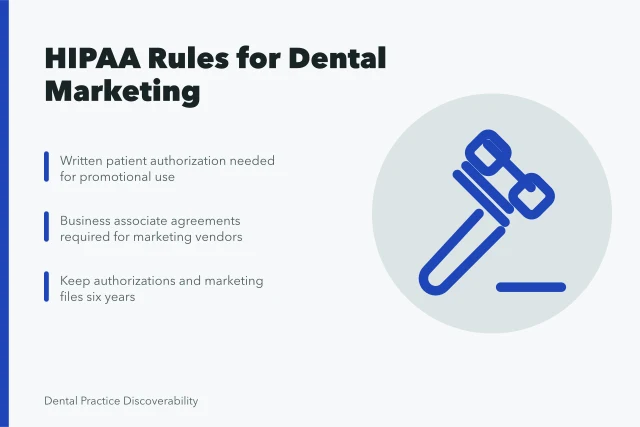
Joint HHS and FTC guidance on consumer health information says a covered entity or business associate must obtain a valid HIPAA authorization to use or disclose protected health information for marketing. It also explains that the FTC Act reaches deceptive health-data practices. Classify the organization, information, and communication before publishing or targeting it.
What do state dental boards and the ADA require?
State dental boards and the ADA set advertising rules. Many states require the treating dentist's name and license number on ads. Some ban guarantees of results or require a disclaimer for specialty claims.
The ADA Code says advertising must not be false or misleading; check your state board and dental society for exact rules.
How do we manage account access and accessibility?
Account access should not sit with one person. Use a shared password manager and require two-factor authentication. Keep a list of who holds admin rights for each platform. When staff leave, remove their access the same day and change passwords. Document the handover in writing.
Make posts and replies readable. Add alt text to images. Caption videos and provide a transcript for audio. Check color contrast. Avoid flashing images. These steps help patients with disabilities and meet your ethical duty.
How do we document a decision?
Create a short decision card for staff. Is there any identifiable person or health information? Is the claim clinical or promotional? Is anyone receiving value? Who owns the media? Can the content be understood accessibly? Where should private replies go? Who has final approval? If any answer is unclear, hold the post.
Questions should end with an accountable action, not a guess. Record the reviewer, source, release, publication date, and change trigger. Platform features and laws evolve, so a past approval is not permanent permission for new wording, a new audience, or a new use.
For common dental social media questions, keep the evidence record beside the decision so a reviewer can reproduce the reasoning without relying on memory.
The GAO evaluation design guide connects evaluation questions with evidence needs and design choices. Apply that discipline to common dental social media questions; federal evaluation guidance does not make a local marketing result causal or transferable.
The W3C Privacy Principles statement gives web-system designers shared privacy concepts and warns against shifting privacy work to individuals.
Common questions
Can a staff member film in an empty treatment room?
Yes only after checking screens, papers, reflections, audio, rights, safety, and practice approval.
Is a hashtag enough for sponsorship disclosure?
Only if the disclosure is clear, understandable, and hard to miss in context. Vague abbreviations can fail.
Can social media replace a patient portal?
No. Use approved secure channels for personal clinical, scheduling, billing, and record communication.