Strategy
Part of Dental SEO: signal versus noise, updated for 2027
Before you act on dental SEO trends (2027 update)
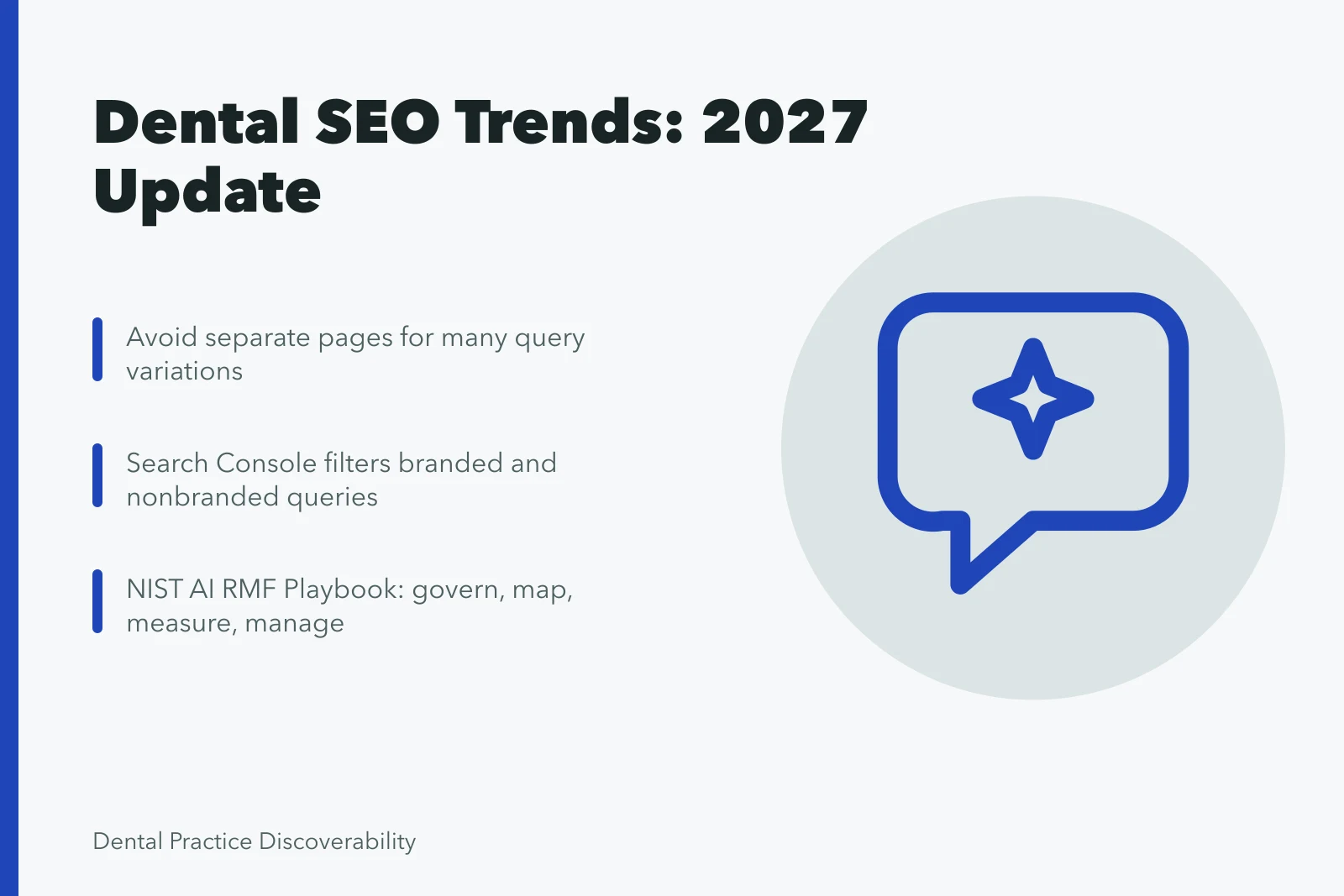
Google warns against generating query variants at scale, and Search Console's branded query filter remains a rough label, not a ranking signal.
What to take away
- Dental SEO trends in 2027 show up as changes in search interfaces, content production, media and reporting. None of them changes the basic duty: publish accurate practice facts, support clinical claims, protect patient information, and keep a usable path to care.
- Name the trends before spending on themGoogle AI Overviews and AI Mode, the Search Console branded query filter, and Interaction to Next Paint in Core Web Vitals.
- Keep verified practice facts, claim approvals and raw exports outside the publishing tool.
One thorough page for one patient need is the recommended shape. Generative answers pull from pages that are easy to verify. A page carrying the practice's address, hours, services, fee approach and the college-approved wording for any claim beats ten thin pages that each cover a near-duplicate phrasing.
| Query pattern | What it usually signals | What to do instead |
|---|---|---|
| "dentist near me" plus every suburb name | Location pages built for coverage | One page per real location, with its own hours and phone |
| Every phrasing of one procedure | Query fan-out chasing | One page answering the whole decision |
| Symptom phrased as a question | Informational intent, not booking intent | Answer it, link to the service page, do not build a booking page for it |
| Brand name plus a competitor | Comparison intent | Leave it; do not build a page per rival |
The 2027 dental SEO watchlist, named and dated
2027 dental SEO watchlist
| Trend or tool | Status | Concrete detail | Before you act |
|---|---|---|---|
| Google AI Overviews and AI Mode | Shipped, expanding | Google's AI features guidance says core SEO practices apply; no special file or markup is required | One complete page per patient need |
| Search Console branded and nonbranded filter | Shipped | Shorter history than unfiltered data; classification errors documented | Export raw queries, check boundary cases |
| Interaction to Next Paint | Shipped March 12, 2024 | Replaced First Input Delay; good is 200 ms or less, with LCP 2.5 s and CLS 0.1 | Test the booking page on a mid-range phone |
| schema.org Dentist markup | Shipped | Dentist sits under LocalBusiness and MedicalBusiness; markup must match visible content | Publish address, phone, hours and services once |
| Google Business Profile local pack | Shipped, updated often | Google names relevance, distance and prominence as local ranking inputs | Match name, address and phone everywhere |
| Scaled content abuse and site reputation abuse policies | Shipped since March 2024 | Cover mass-produced pages and hosted content that trades on another site's ranking | Do not host third-party content on the practice domain |
| GPTBot, OAI-SearchBot, PerplexityBot | Shipped | OpenAI and Perplexity publish these crawler names; blocking them removes pages from those answers | Set crawler access in robots.txt on purpose |
| llms.txt | Announced proposal | Community proposal for a markdown file of key links; Google's AI features guidance does not require it | Watchlist only, no build |
| Ahrefs, Semrush, Bing Webmaster Tools | Shipped | Bing Webmaster Tools is free with a verified site; Ahrefs and Semrush entry tiers typically run about $30 to $150 a month | Keep one source of truth, date every export |
Label every row shipped, limited release, preview, announced or inferred. A shipped feature can support a planning decision. An announced one cannot support a guaranteed 2027 price, ranking or outcome.
To verify a status, open the vendor's own documentation page and find the dated entry for the change. Record the release name or version next to the label. The status comes from that page, not from a reseller summary. Recheck the vendor's own documentation before any build.
Google's warning is about scale, not about AI
Google's guide to optimizing for generative AI features says the same foundational practices apply, and warns against producing separate pages for many query variations mainly to manipulate rankings or generative responses. The problem is the pattern, not the tool.
Query patterns vs recommended pages
Query pattern
- Suburb name pages
- One page per real location
- Every procedure phrasing
- One page for whole decision
- Symptom question
- Answer, link to service page
- Brand plus competitor
- Leave it, no page per rival
What to do instead
- Suburb name pages
- Every procedure phrasing
- Symptom question
- Brand plus competitor
The branded query filter is a label, not a measurement
Search Console's documentation on performance dimensions and groupings describes branded and nonbranded query filtering, along with history, availability, anonymization and possible classification errors. Treat the filter as an analytical aid.
Two caveats matter when a practice reports on it. History does not stretch back as far as the unfiltered data, so a branded-only trend line can start later than the practice's own records. Classification is also imperfect: a query containing the practice name plus a procedure may land in either bucket depending on how the system reads it.
Before quoting a branded share in a partner or associate meeting, export the raw query list and check the boundary cases yourself. State the date range and the filter setting next to the number.
Choose the patient task before the trend label
A trend is only actionable if it maps to something a patient is trying to finish. Three tasks cover most of what a dental site is for:
Choose the patient task
- Find the correct location and confirm it is open.
- Understand what a service involves and what it costs to start.
- Reach a person, by phone, form or booking link, without a dead end.
Write the task down, then ask whether the trend changes the page that serves it. If it does not, the trend belongs on the watchlist, not in the build queue.
Keep the evidence beside the decision
The NIST AI RMF Playbook lists voluntary risk actions under govern, map, measure and manage. Use it when a vendor's AI feature touches patient inquiries. It is not a product ranking or a forecast.
The W3C Privacy Principles statement gives web-system designers shared privacy concepts and warns against shifting privacy work onto individuals. Apply it to how inquiry data moves, then check the governing law and the practice's own configuration.
Name the affected workflow, the source, the owner, the test and the rollback condition. Recheck the primary page before publication and again before adoption.
Store the evidence beside the decision, so a reviewer can reproduce the reasoning without asking who remembers it. Date the next review and state which change would force an earlier one. Keep rejected options in the file next to the chosen path, since the constraint that decided the matter may later move.
Common questions
Does generative search require different dental content?
No separate content type is universally required. Publish accurate, useful, accessible information for real patient tasks, and let the same page serve both classic results and generative summaries.
Should a practice build a page for every AI query phrasing?
No. Google's guidance warns against producing separate pages for many query variations mainly to manipulate rankings or generative responses. Build one complete page for a coherent patient need.
Are branded query filters exact?
No. Search Console documents history, availability, anonymization and possible classification errors for these groupings. Export the raw query list and check the boundary cases before quoting a branded share.
Which Core Web Vitals metric changed for 2027 planning?
Interaction to Next Paint replaced First Input Delay on March 12, 2024. The good thresholds are 200 ms or less for INP, 2.5 seconds for LCP and 0.1 for CLS. Test the booking page on a mid-range phone over mobile data.
Who sets the rules for dental advertising and patient data in Canada?
The provincial dental regulatory college sets advertising standards, and the Office of the Privacy Commissioner of Canada or the relevant provincial commissioner oversees privacy law. Confirm the current requirement with the college and retain counsel for CASL, PIPEDA, PHIPA and Quebec Bill 96 questions.
For a US practice, the equivalent sources are the state dental board for advertising standards, the Federal Trade Commission for claim substantiation, and HIPAA for patient data.