Careers
Part of Dental social media: workflows and safeguards
Dental social media mistakes: recording a correction
Dental social media mistakes can outlast a deleted post. Learn what to preserve, how to document a correction, and how to prevent the same error.
What to take away
- A removed post can still require incident handling.
- Testimonials become advertising when the practice features them.
- Fix the workflow that allowed the error, not only the visible post.
Dental social media mistakes can harm patients and the practice long after a post is removed. The response should stop further exposure, preserve evidence, involve the right owner, correct public information when needed, and change the approval control that failed.
Seven common failures
| Mistake | Immediate response | System fix |
|---|---|---|
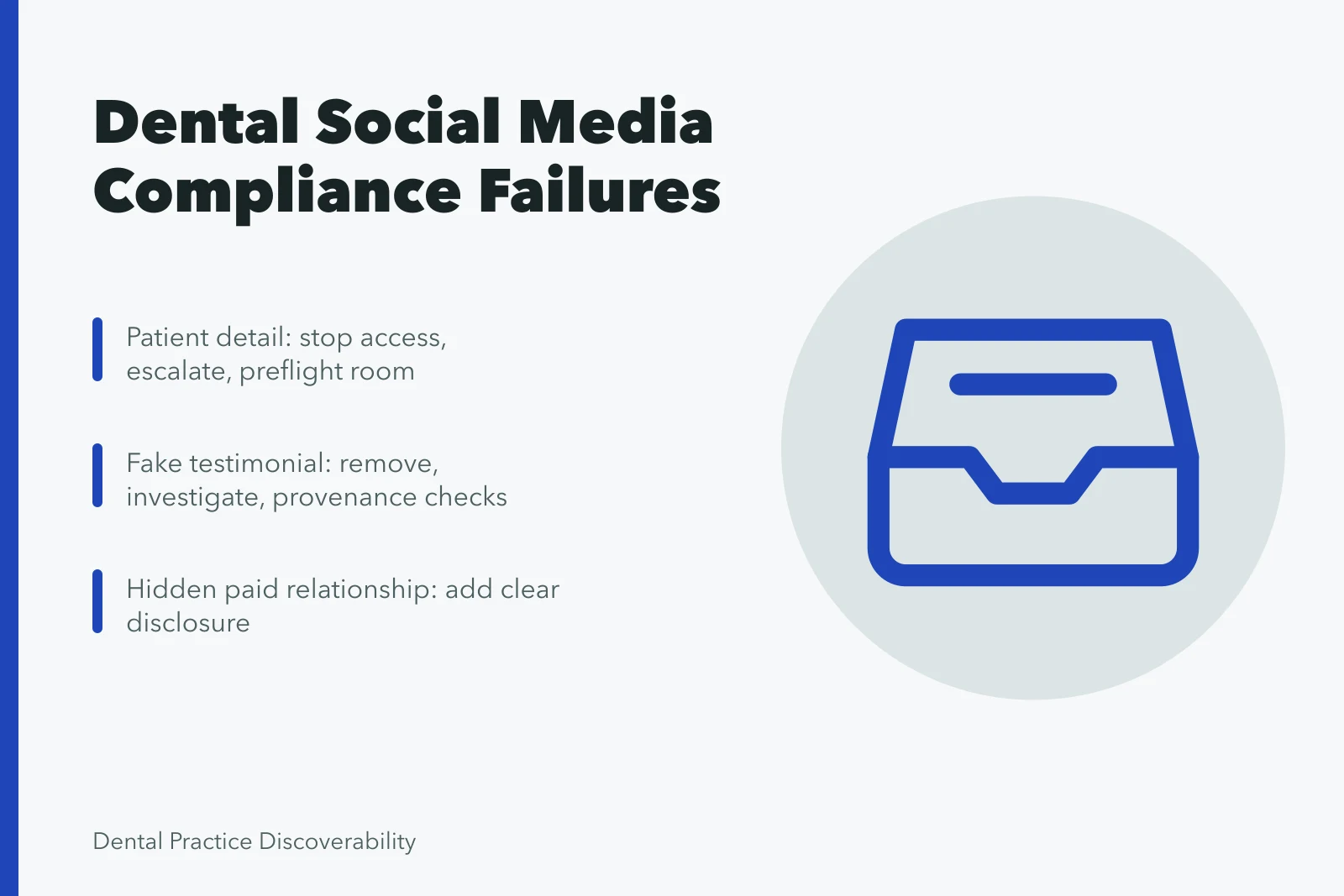
| Patient detail appears | Stop access and escalate | Preflight room and media |
| Unsupported treatment claim | Correct or withdraw | Claim register and clinical review |
| Fake or edited testimonial | Remove and investigate | Provenance and approval checks |
| Hidden paid relationship | Add clear disclosure | Creator contract and monitoring |
| Unreadable or uncaptioned media | Publish an accessible alternative | Accessibility review before release |
| Shared account password | Rotate and review access | Named roles and MFA |
| Vanity-only report | Restate the decision | Task and outcome measures |
Do not manufacture praise
FTC staff answer detailed questions about the Consumer Reviews and Testimonials Rule including fake or false reviews, insider relationships, incentives, suppression, and featured testimonials. The guidance notes that a review featured in marketing becomes a testimonial rather than mere hosting. Apply current law to the campaign's facts.
Sample disclosure for paid creator content: 'This is a paid promotion for [Practice Name]. I received compensation.'
Do not treat de-identification as casual editing
HHS guidance on de-identifying protected health information explains the Expert Determination and Safe Harbor methods under the HIPAA Privacy Rule and notes that identification risk is not necessarily zero. Cropping a name or blurring a face is not a general de-identification method for social content.
Use a correction record with the original post, capture time, exposure, issue, decision, corrected wording, notification, reviewer, and prevention action. Avoid arguing in comments. If the error affected a person, a legal duty, or clinical safety, follow the practice's formal incident and advice process.
Before: 'Painless implants while you wait.' After: 'We offer implant consultations; options and timelines depend on an examination.'
Review near misses too. A draft caught before publication can reveal weak staging, unclear creator instructions, missing sources, excessive access, or a rushed review. Recording the cause helps the team prevent the next version from reaching the public.
Document the correction
For dental social mistakes, compare the published post with its approved wording and supporting material. Record what changed, who reviewed it, and whether the correction affects other versions of the same content.
The FTC advertising substantiation policy requires a reasonable basis before objective advertising claims are disseminated. For a dental practice, retain the support for each claim and review any correction before republishing it.
A dashboard change does not close a social media mistake. Trace the correction from the original post through any reposts, reports, and decision owner. Preserve the prior wording, reason for change, reviewer, and actions taken.
Then test whether the same defect can recur. This turns an error list into an operating control and gives later readers evidence the published conclusion was repaired.
Keep the evidence record beside the decision. A reviewer can then reproduce the reasoning without memory.
Set the next review date and the trigger for an earlier check. Record rejected options and the chosen path. Close unused reports and permissions after the decision cycle ends.
Common questions
Is deleting a mistaken post enough?
No. Assess exposure, preservation, correction, notification, reporting, and the process failure with the responsible specialists.
Can a practice write a testimonial for a patient to approve?
Do not create words that misrepresent a person's real experience. Review testimonial and advertising requirements for the facts.
Does blurring make a patient image safe?
Not by itself. Authorization, access, context, metadata, surrounding details, and applicable privacy rules still matter.