Reviews
Part of Dental marketing strategy compared with what actually happens
Dental marketing strategy tools judged on daily use
dental marketing strategy tools in 2027 should be compared through real tasks for listings, publishing, calls, campaigns, analytics, privacy, exports, and support.
What to take away
- Shortlist software from the patient path and operating requirements.
- Rebuild one complete campaign record in every finalist.
- Include implementation, governance, and exit work in total cost.
Dental marketing strategy tools span listing management, content publishing, call handling, forms, and campaign delivery. They also cover analytics, consent, review workflows, and reporting. A broad platform may cover several jobs, but no product removes the practice's duty to verify claims, patient paths, access, and data use.
Dental marketing strategy tools judged on daily use need named candidates. Google Business Profile handles listings and reviews for free. Podium and Weave cover messaging and calls, usually by quote. CallRail lists call tracking plans from around $45 per month. Patient Prism scores dental calls by quote. Mailchimp, HubSpot, GA4, and Semrush cover campaigns and analytics.
Judge Google Business Profile, Search Console, and GA4 on search tasks
Google's documentation for the Search Console Performance report defines clicks, impressions, click-through rate, average position, and filters. It also defines dimensions. The report covers eligible Google Search activity for the verified property. It does not count appointments or all search demand.
Google Business Profile is free for a verified location. It manages listings, posts, Q&A, and messages. Use it to correct hours, services, and review replies daily. It does not hold appointment or clinical records.
Google Analytics 4 is free with a 14-month data retention limit on the standard property. It records campaign labels and events. It does not establish consent, patient identity, revenue, or clinical outcome.
Semrush lists a Pro plan around $139.95 per month for keyword and competitor tracking. Ahrefs lists a Starter plan around $29 per month for site and backlink checks. Both fit weekly search checks, not patient data.
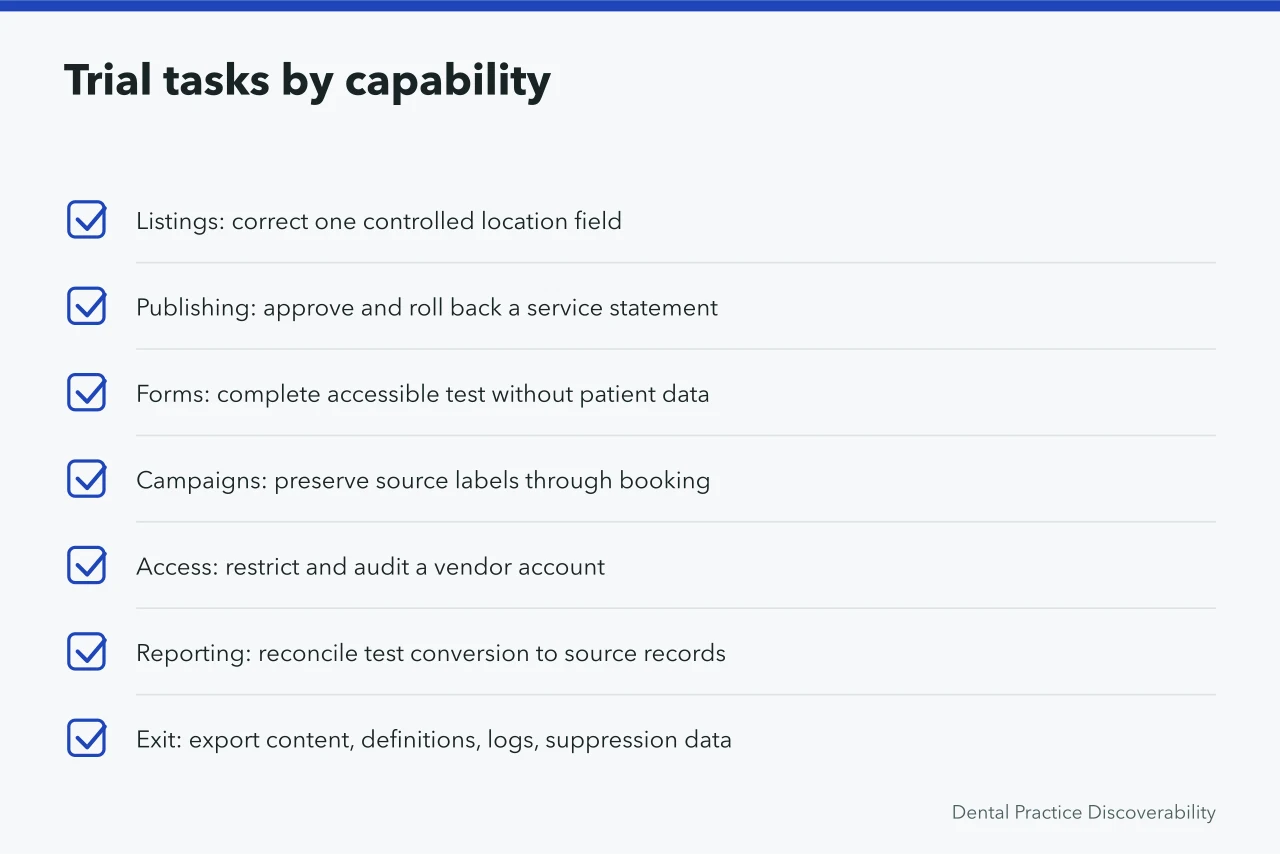
| Capability | Trial task |
|---|---|
| Listings | Correct one controlled location field |
| Publishing | Approve and roll back a service statement |
| Forms | Complete an accessible test without patient data |
| Campaigns | Preserve source labels through booking |
| Access | Restrict and audit a vendor account |
| Reporting | Reconcile a test conversion to source records |
| Exit | Export content, definitions, logs, and suppression data |
| Google Business Profile | Correct one controlled location field; free listing |
| CallRail | Preserve call source labels through booking; plans from about $45 per month |
| Mailchimp | Approve and roll back an email campaign; free to 500 contacts |
| Podium | Test message and review workflows; quote-based |
| GA4 | Reconcile a test conversion to source records; free with 14-month retention |
Standardize campaign labels in HubSpot, Mailchimp, and GA4
Google's guide to campaign URL parameters describes UTM fields and notes that parameter values are case sensitive. These parameters help label referring campaigns in Google Analytics. They do not establish consent, patient identity, revenue, or clinical outcome.
HubSpot's Starter Customer Platform lists around $20 per month per seat. It covers forms, landing pages, and source tracking. Mailchimp's free plan covers up to 500 contacts, and Essentials starts around $13 per month. It fits email campaigns and recall sends.
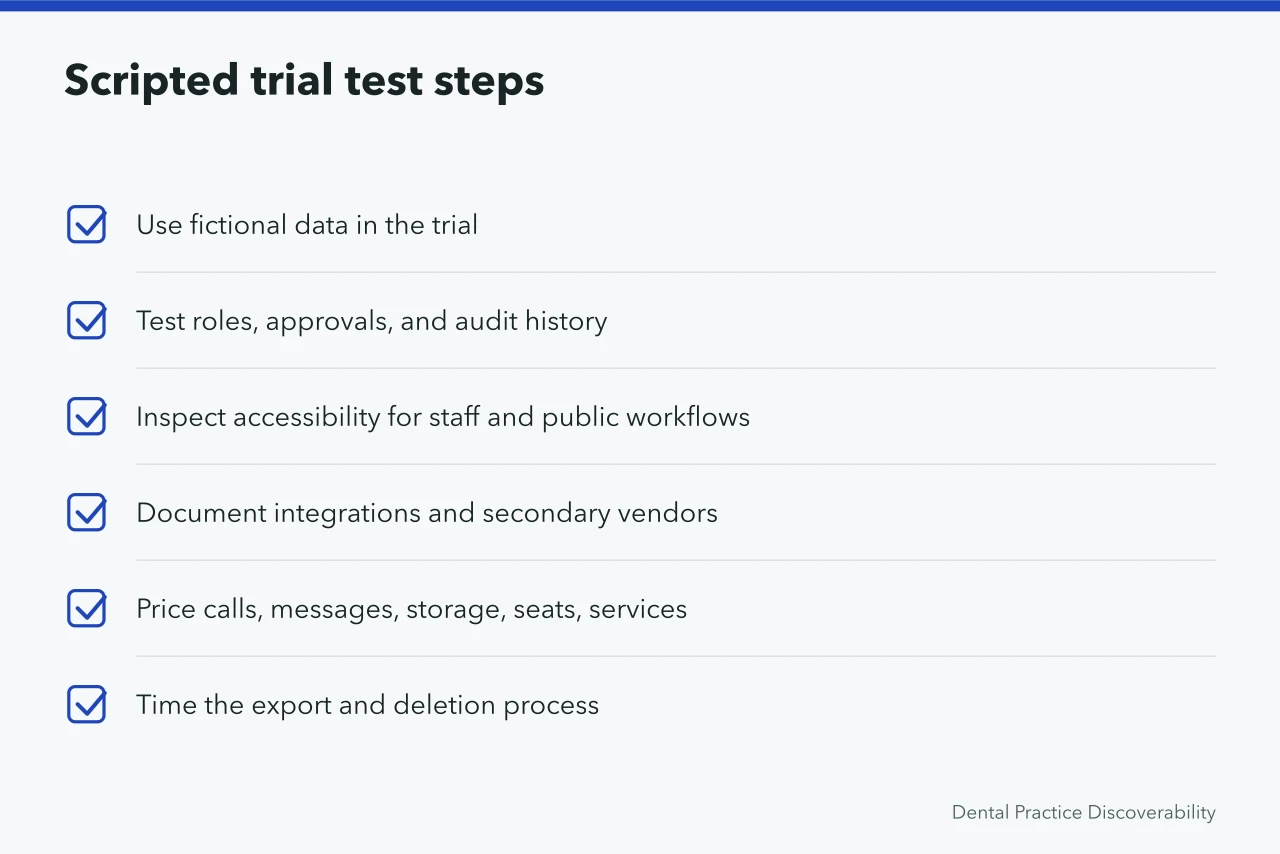
- Use fictional data in the trial
- Test roles, approvals, and audit history
- Inspect accessibility for staff and public workflows
- Document integrations and secondary vendors
- Price calls, messages, storage, seats, and services
- Time the export and deletion process
Score actual results from a scripted test, not a sales presentation. Keep the plan, account configuration, screenshots, and errors. Also keep support exchanges, export, and reviewer notes. Reject a tool that produces a polished dashboard the team cannot explain or reconcile.
Include a failure rehearsal. Disable an integration, submit an invalid form, rotate an access credential, and remove a test record. The team should know how errors surface, who receives them, and how to restore service without exposing patient information.
Ask the people who will use the system every day to score the trial. Their time, workarounds, and error recovery belong in the decision alongside license price.
Test the operating burden of Podium, Weave, Patient Prism, and Yext
The GOV.UK technology selection guidance recommends adaptable choices, data control, security review, and ownership-cost analysis. Use those public-service questions when assessing dental marketing strategy tools; they are not product endorsements. Public-service questions like these also shape dental marketing strategy development, where each choice gets tested against real constraints.
Podium and Weave quote per location, often in the low hundreds to several hundred dollars monthly. Both cover texting, reviews, and payments. Weave also connects to Dentrix, Eaglesoft, and Open Dental for phone and reminder workflows.
Patient Prism tracks and scores inbound dental calls, usually by quote per location. It fits front-desk coaching and missed-call review. Yext manages listings and knowledge panels, usually by enterprise quote. It fits multi-location name, address, and phone control.
The GOV.UK open standards guidance links open standards with interoperability and reduced supplier dependence. Test whether dental marketing strategy tools data and definitions can move, while keeping the page's UK public-service context clear.
Open Dental publishes self-hosted software and paid support plans, typically around $179 per month per location. Dentrix and Curve Dental quote by practice size and modules. These systems hold the appointment and patient record that marketing tools must reconcile to.
Give each tool the same source sample, user roles, required output, failure case, and export task. Measure setup time, recurring labor, specialist help, correction work, and shutdown effort.
A feature earns credit only when an intended user completes the task safely. Save the tested plan and date; a current product page does not promise the same function or price in 2027.
Keep the evidence record beside the decision so a reviewer can reproduce the reasoning without relying on memory. Set the next review date and name the change that would trigger an earlier check.
Record rejected options as well as the chosen path because the original constraint may later change. Use the same definitions in the interface, export, meeting note, and correction log. Close unused reports and permissions after the decision cycle ends. Rejected options and shared definitions also matter in dental marketing strategy mistakes, where weak consent and vanity metrics quietly persist.
Common questions
Which dental marketing tool is best?
The best fit passes the practice's defined task, security, privacy, and access tests. It also passes measurement, support, cost, and exit tests.
Does a practice need one integrated suite?
No. Integration may simplify work, while smaller tools may improve control or fit. Test the actual architecture.
Should call recording be enabled?
Only after qualified review of consent, privacy, security, and retention. Access and operational need also require review.
Which named tools fit a small dental practice?
Google Business Profile for free listings, Mailchimp for email, CallRail for call tracking, HubSpot for forms, and Open Dental or Dentrix for records. Add Podium or Weave when texting and reviews justify the monthly quote.