Strategy
Part of Dental marketing strategy compared with what actually happens
Reading dental marketing strategy benchmarks without fooling yourself
dental marketing strategy benchmarks in 2027 should compare matched patient journeys, capacity, attendance, cost, access, and data quality with clear definitions.
What to take away
- Population health data is context, not a practice conversion target.
- Channel reports use different scopes and counting rules.
- Matched internal cohorts are usually the safest first comparison.
Dental marketing strategy benchmarks should help a practice make a decision without hiding differences in audience, service, capacity, channel, location, season, or measurement. Start with a stable internal baseline and show raw counts beside every rate.
Separate market context from performance
CDC's National Center for Health Statistics provides oral health estimates in its Data Query System for topics such as dental visits, caries, and tooth loss. These survey-based population estimates can frame local questions. They are not advertising benchmarks or proof that a specific practice can serve the measured need.
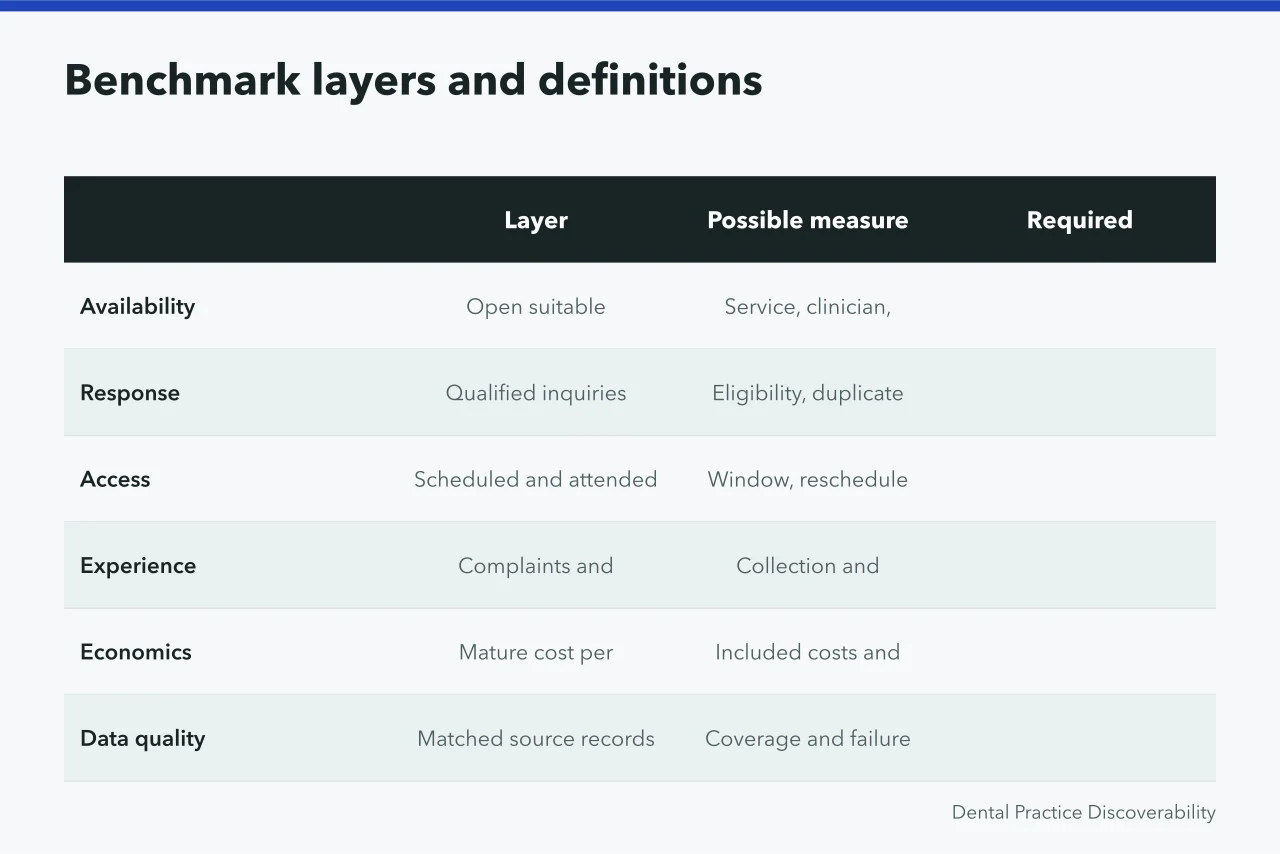
| Layer | Possible measure | Required definition |
|---|---|---|
| Availability | Open suitable appointment slots | Service, clinician, and time |
| Response | Qualified inquiries | Eligibility and duplicate rule |
| Access | Scheduled and attended visits | Window and reschedule logic |
| Experience | Complaints and assistance requests | Collection and denominator |
| Economics | Mature cost per attended patient | Included costs and cohort |
| Data quality | Matched source records | Coverage and failure rule |
Know the platform's counting scope
Google explains the difference between user and traffic acquisition reports: one focuses on how new users were first acquired, while the other is scoped to sessions. Those definitions are specific to Google Analytics and cannot be substituted for a practice's appointment records.
Create a benchmark card for every comparison. Include formula, numerator, denominator, patient or session unit, service, geography, channel, dates, cohort age, exclusions, data source, cost scope, owner, and uncertainty. Reject an agency average that omits these fields.
Compare the same stage at the same maturity. A cost per form submission cannot be compared with a cost per attended new patient. A seven-day campaign cannot be judged on completed care. Annotate holidays, staffing changes, outages, benefit changes, and capacity limits.
Publish a small data-quality panel beside the benchmark. Show the share of inquiries matched to a source, the proportion still pending, and known call or form outages. A precise rate built from incomplete records should not look more certain than it is.
Make the comparison reproducible
The GAO evaluation design guide connects evaluation questions with evidence needs and design choices. Apply that discipline to dental marketing strategy benchmarks; federal evaluation guidance does not make a local marketing result causal or transferable.
The NIST experimental design selection guidance begins design choice with the objective and practical constraints. It supports separating dental marketing strategy benchmarks reporting from controlled effect estimates, not turning observation into causation.
Before comparing results, state benchmark population, period, inclusion rules, calculation, and currency. Also state maturity window and uncertainty. Keep market context separate from an internal target. Recalculate from the cited source or governed dataset, then record any mismatch.
A benchmark becomes useful only after the local team explains why the comparison group and method fit the decision. A written benchmark card feeds the dental marketing strategy checklist, which catches missing fields before decisions.
For dental marketing strategy benchmarks, keep the evidence record beside the decision so a reviewer can reproduce the reasoning without memory. Set the next review date and name the change that triggers an earlier check.
Record rejected options as well as the chosen path because the original constraint may later change. Use the same definitions in the interface, export, meeting note, and correction log. Then close unused reports and permissions after the decision cycle ends.
Common questions
What is a good dental marketing conversion rate?
There is no universal rate. Define the stage, audience, channel, service, time window, and counting method, then compare matched cohorts.
Can national oral-health data set a lead target?
No. It describes population estimates, not local intent, eligibility, access, competition, or practice capacity.
How often should benchmarks be reset?
Review after material definition, service, staffing, channel, market, or tracking changes.