Careers
Part of Dental marketing strategy compared with what actually happens
Notes on dental marketing strategy trends from the field, 2027 edition
dental marketing strategy trends in 2027 include tracking controls, influencer ethics, accessible journeys, source reconciliation, and portable records.
What to take away
- The 2027 trends that matter are regulatory and structuralHIPAA review of website tracking, claim substantiation in social marketing, review integrity, AI answers in search, and consent rules across borders.
- None of them is fixed by a new channel. They are review, architecture and record-keeping problems.
- Audit tracking tags, correct business listings, substantiate every claim, and keep a dated evidence file.
- Judge a trend on the patient problem it solves, the evidence behind it, the new risk it creates, and the result that would make you stop.
The 2027 trends worth tracking
These are operating signals, not forecasts. Each has a dated trigger, and each changes what a practice must show a board or a regulator.
2027 trends worth tracking
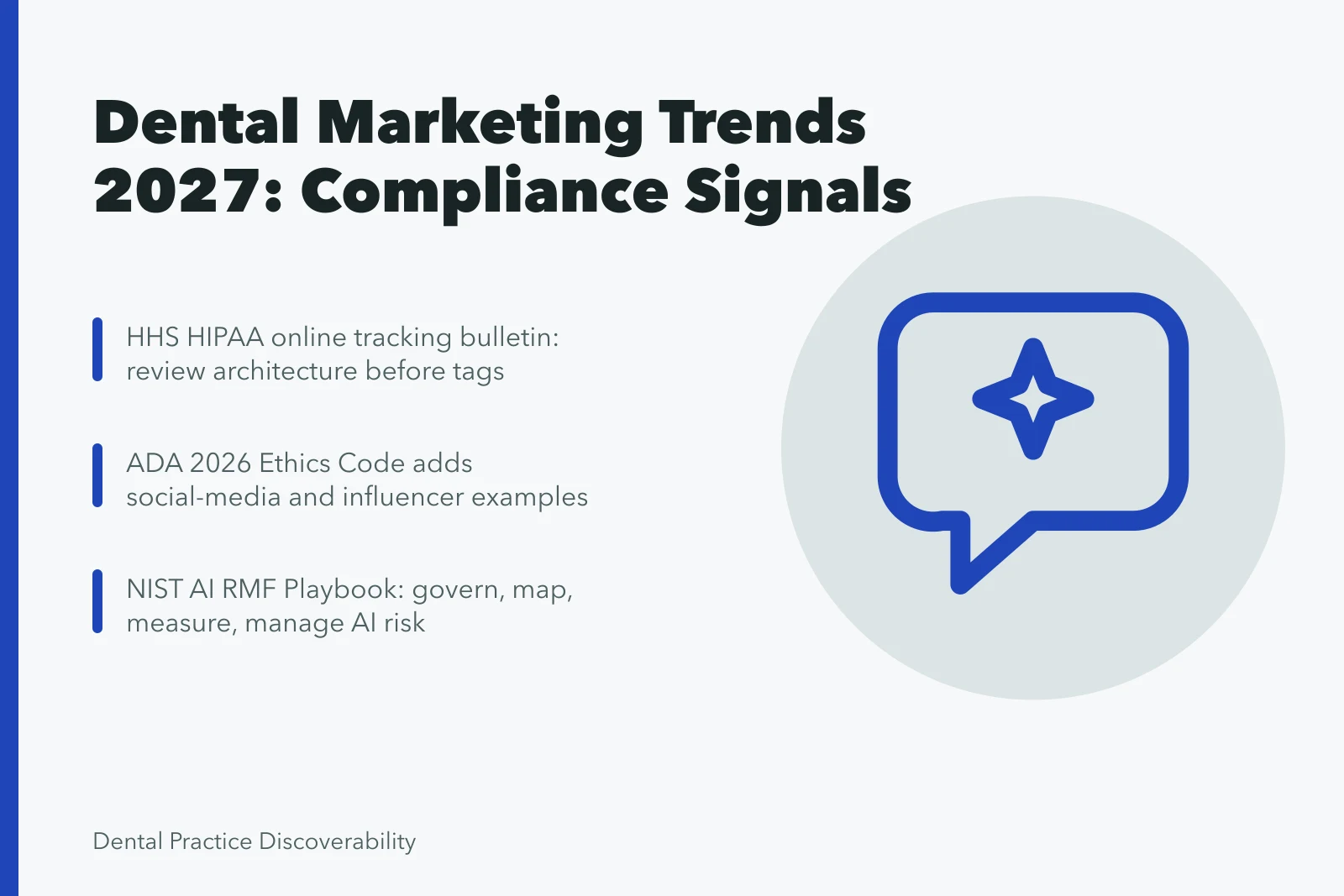
- Website tracking under HIPAA. HHS OCR's online-tracking bulletin, issued March 2024 and revised since, covers tags on pages that handle health information.
- Social claims. The ADA Code of Ethics reviews advertising under its veracity principle and is updated annually. The FTC's health products guidance dates from December 2022.
- Review and local-result integrity. Google publishes local ranking factors and a review policy with a reporting route.
- AI answers in search. Generated summaries appeared above ordinary results from 2024, and they cut clicks to listings below.
- Cross-border consent. PIPEDA governs commercial data handling in Canada. Quebec's Bill 96 French-language duties for commercial publications took effect on June 1, 2025.
Any dental marketing strategy discussion in 2027 starts here, since these five decide what a practice can publish or claim.
What the HIPAA tracking guidance requires of a practice site
The test is whether a tag discloses protected health information to a vendor. OCR's online tracking rule treats an IP address plus a visit to a condition page as health information.
If the vendor will not sign a business associate agreement, the tag comes off the pages in scope.
HIPAA tracking guidance requirements
| Tracking signal | Operational response |
|---|---|
| A pixel fires on a service page naming a condition | Remove it, or move it to a page that collects nothing identifiable |
| A vendor refuses a business associate agreement | Treat the tag as a disclosure to remove |
| A chat widget captures symptoms before log-in | Move intake behind authentication |
| A retargeting audience is built from appointment pages | Delete the audience and block the source event |
Tracking Decision Checklist
- Map collection and onward disclosure
- Preserve source and consent labels
- Approve claims and material connections
- Require clinical and factual review
- Test tasks manually and with users
- Export definitions, content, and evidence
That table doubles as an audit sheet. Work it once, record the date, and recheck when tags or vendors change.
Influencer and social claims are professional claims
A paid post by a local creator is the dentist's claim, not the creator's opinion. The ADA Code of Ethics holds statements about care to a truthfulness standard and applies it to social channels in the same terms as print.
Influencer and social claims
- Label every paid partnership, since the FTC health products guidance covers endorsements.
- Hold written substantiation for each clinical claim, including before-and-after images.
- Keep final approval with a named clinician, not an agency manager.
Substantiation is easier to defend when review steps follow dental marketing strategy best practices for source checking and claim approval.
Local results, reviews and AI answers
Google ranks local results on relevance, distance and prominence, and its guidance on improving local ranking shows how categories and business information feed relevance. A wrong category pushes a practice down for searches it already serves.
Google's review policy lists prohibited content and a route to report it. Ask for reviews, never buy them, and never reply with patient details.
AI summaries now answer many first searches. The practice named in a summary takes the click, so hours, services and insurance need to match across your site, your profile and every directory.
Canadian rules that moved
PIPEDA covers commercial handling of personal information, including ad audiences assembled in Canada. The Canadian privacy law picture for dental marketing explains where provincial health statutes add their own conditions. Quebec also requires French-language commercial publications under Bill 96, which reaches service pages, ads and signage.
How to review a trend before you commit
How to review a trend
- Write the patient or operating problem in one sentence, with the current number attached.
- Open the primary page for the tool or rule and record its publication date.
- List the data it would touch and every party that would receive it.
- Run a limited test with a named owner, a written stop condition and a review date.
- File the decision, including the options you rejected and why.
Step three rewards outside frameworks. The NIST AI RMF Playbook sets out govern, map, measure and manage actions. The W3C Privacy Principles argue against shifting privacy work onto individuals, which is a useful check on consent design.
The record that keeps a practice defensible
A portable file beats a vendor dashboard, because dashboards close when contracts end. The dental marketing strategy checklist covers the wider audit that catches gaps an internal review misses.
- Verified practice factsservices, hours, insurance, locations.
- Approved claims with the source and the approving clinician named.
- Consent records for email, texts and ad audiences.
- A tag inventory with vendor agreements on file.
- Metric definitions and the raw export behind each reported figure.
- The watchlist, with review dates and rejected options.
Example: one trend reviewed and declined
This is an illustrative scenario, not a reported case. A two-location practice weighs an AI phone assistant after an outbound pitch. The manager writes the problem as missed calls after 5pm and finds the vendor's retention terms undated on its security page.
A four-week pilot on one line hits its stop condition. The practice declines the contract and files a one-page note naming the reviewer, the dates and the reason.