Rules
Part of Dental marketing strategy compared with what actually happens
Dental marketing strategy case studies: the results and the conditions behind them
Dental marketing case studies from named campaigns show measured results, the local conditions that limit copying them, and what a practice can test.
What to take away
- Real published dental cases report a method and the conditions around it. Some report a measured outcome. None reports cost per new patient for a private clinic.
- Watch Your Mouth was evaluated on public beliefs about children's oral health across four states, using paid media, earned media, organizing and advocacy.
- The NIDCR pediatric study measured visit completion after providers received support, inside its own eligibility rules.
- Cost per booked appointment is the only figure that compares channels fairly, and only against your own baseline.
- File the source, the population and the stop rule beside the decision, or the reasoning is gone by review time.
What the two published cases actually measured
Neither of the two published cases below is a clinic campaign. One is a public-health media campaign. The other is a provider-support study. Both report an outcome. Neither reports a cost per appointment.
| Case | Who was studied | What was delivered | What was measured |
|---|---|---|---|
| Watch Your Mouth | Public audiences in four states | Paid media, earned media, community organizing, policy advocacy | Beliefs and awareness about children's oral health |
| NIDCR provider support study | Children inside the study's eligibility rules | Support given to pediatric providers | Whether dental visits followed |
Anyone reading dental marketing benchmarks should first check what the study counted. That page explains why the unit of measurement decides whether a number is worth using.
Case 1: Watch Your Mouth and its perception endpoint
The Watch Your Mouth campaign ran in four states and was evaluated on what people believed about children's oral health. The published endpoint was perception, not appointments.
That distinction decides whether you can use it. A campaign measured on belief change tells you which message moved people. It cannot tell you cost per new patient, because no appointment was ever the endpoint.
The child angle travels. Parents often act on a child's visit before their own recall appointment, so children's oral health framing fits recall messaging.
The budget structure does not travel. Paid and earned media at state scale has no equivalent line in one clinic's marketing plan.
Case 2: NIDCR provider support and visit completion
NIDCR reports that support for pediatric providers increased dental visits. The intervention and the population define the result. Read it as evidence that a professional handoff can move visit completion, not as an advertising promise.
The transferable piece is the referral workflow. Test it with one partner group and a written stop rule.
- Referral criteria agreed in writing with the partner
- What the referring team sends, kept to one page
- Booking route, and who answers it
- Confirmation that the visit actually happened
- Stop rule and a review date
Measure completeness of referrals and attended suitable visits. Volume alone proves nothing.
Example: recall arithmetic built from your own list
This is an illustrative model, not a case result. It uses your numbers only.
- Count patients overdue by more than 18 months. Call that figure O.
- Count those contactable under valid consent for commercial messages. Call it C.
- Apply your booking rate b and your show rate s from the last comparable campaign.
- Multiply C x b x s x V, where V is the value of one completed hygiene visit.
Published recall rates are not a substitute. Consent coverage and show rates swing widely with how the list was built. Canadian practices need a consent record before the first message, and CASL consent rules set out what a valid record contains.
Then run the campaign and compare cost per booked appointment against your baseline. That comparison is the result.
Comparing channels with cost per booked appointment
| Metric | What it tells you | Where it misleads |
|---|---|---|
| Cost per click | What the platform charged | Nothing about who booked |
| Cost per lead | How many inquiries arrived | Includes people outside your area |
| Cost per booked appointment | What one schedule slot cost | Only comparable inside one practice |
A typical US planning range is USD 150 to 400 per booked new patient. Treat it as a budgeting placeholder, because no cited case published that figure for a clinic.
Keeping the count honest from first inquiry to attended visit is the harder half, and dental patient acquisition covers that ledger.
Advertising claims: FTC first, then provincial colleges
In the United States, the FTC advertising substantiation policy requires a reasonable basis for an objective claim before it runs. State dental boards add their own advertising rules, and HIPAA limits what a practice may say when it answers a review that identifies a patient.
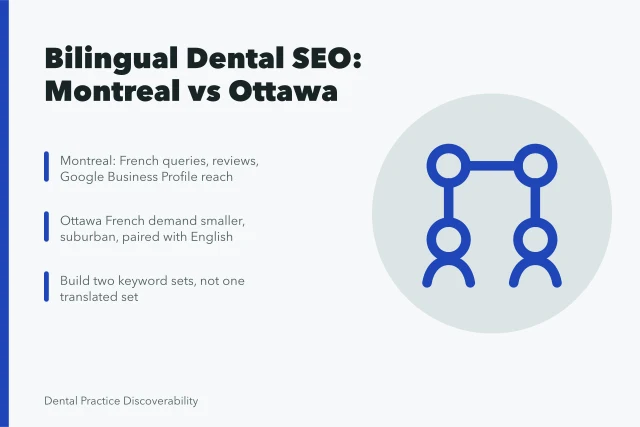
Canada works differently. Provincial colleges publish advertising standards: the RCDSO in Ontario, the CDSBC in British Columbia, the Alberta Dental Association in Alberta. PIPEDA and provincial privacy law govern stored data. Quebec's Bill 96 requires French in commercial communications.
Keep the claim, its evidence and its review date in one place. The dental marketing strategy checklist is built for that file.