Rules
Part of Dental marketing strategy compared with what actually happens
The dental marketing strategy checklist that catches what audits miss
dental marketing strategy checklist covers service scope, patient fit, substantiation, privacy, accessibility, booking capacity, measurement, vendors, and review.
What to take away
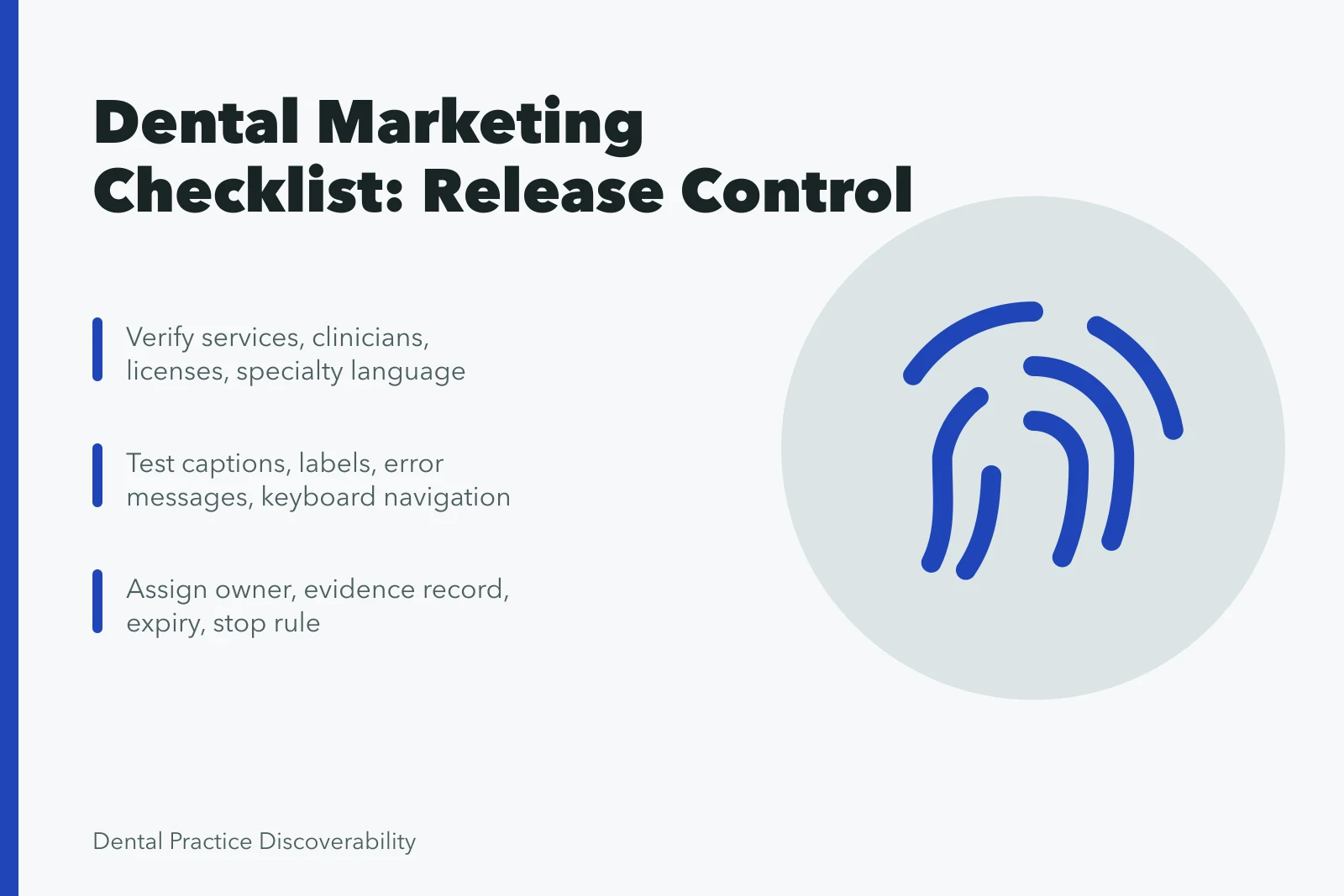
- Verify every public service, credential, price, and availability statement.
- Test the patient path with people and assistive technology.
- Assign an owner, evidence record, expiry date, and stop rule.
A dental marketing strategy checklist should function as a release control. Complete it for the campaign, page, listing, form, call script, vendor, and measurement path. Mark an item approved only when the evidence and accountable reviewer are recorded.
Claims and professional scope
The ADA's detailed guide to dental marketing and advertising describes federal, state, and professional considerations and quotes its ethics rule against materially false or misleading advertising. Confirm current law and board rules for every location.
- Services, clinicians, licenses, and specialty language verified
- Outcome and comparison claims supported and qualified
- Prices, exclusions, financing, and insurance language reviewed
- Testimonials, incentives, and material connections documented
- Translations clinically and culturally reviewed
- Approval and withdrawal dates assigned
Access and patient path
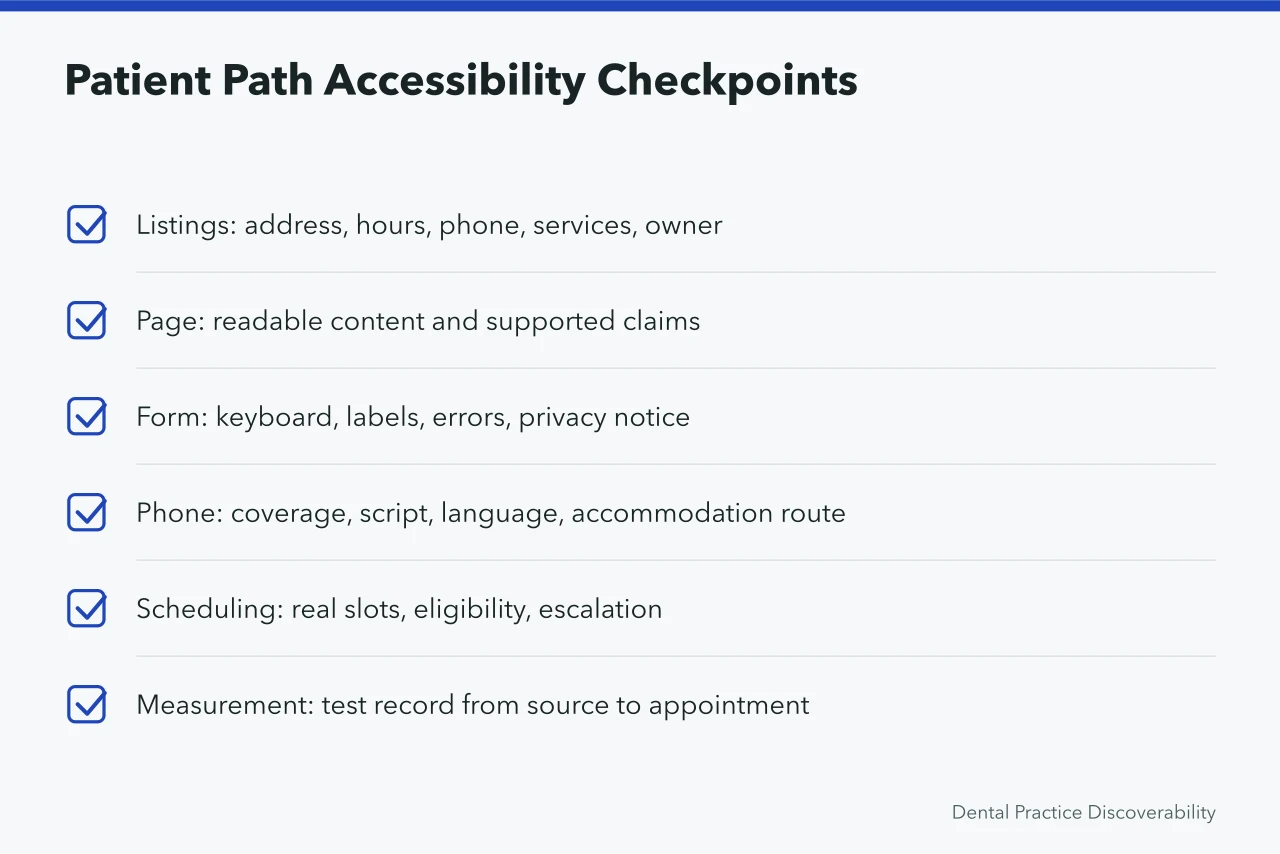
The U.S. Department of Justice's web accessibility guidance describes barriers such as missing captions, unlabeled forms, weak error messages, and mouse-only navigation. It also notes that automated checks should be paired with manual review. Apply qualified advice to legal duties. Manual review of those barriers pairs well with dental website marketing that keeps patient tasks accessible and claims accurate.
| Checkpoint | Proof |
|---|---|
| Listings | Address, hours, phone, services, update owner |
| Page | Readable content and supported claims |
| Form | Keyboard, labels, errors, privacy notice |
| Phone | Coverage, script, language and accommodation route |
| Scheduling | Real slots, eligibility, escalation |
| Measurement | Test record from source through appointment |
Governance and launch
- Vendor access limited and logged
- Data fields tied to a documented purpose
- Retention and deletion behavior tested
- Budget includes labor and software
- Capacity forecast accepted by operations
- Complaint and incident routes staffed
- Pause criteria understood
- Decision review scheduled after outcome maturity
Archive the completed checklist with the exact creative, landing page, parameters, approvals, and screenshots. Reopen it when a clinician, service, price, vendor, rule, location, or patient path changes. A prior approval is not permanent evidence.
Run a final dry test with no real patient information. Confirm the public page, telephone route, form response, scheduling handoff, source label, alert, and deletion behavior. Record the time, tester, result, defect owner, and retest rather than accepting a verbal assurance.
Record the gate result
The W3C Privacy Principles statement gives web-system designers shared privacy concepts and warns against shifting privacy work to individuals. Apply it to dental marketing strategy checklist, then review the governing law and configuration. The same privacy concepts shape the common dental marketing strategy questions practices ask about consent and data use.
The CISA software acquisition fact sheet covers development practice, supply-chain exposure, deployment, and vulnerability management. Add those government-acquisition questions to a dental marketing strategy checklist review without treating them as local approval.
For every checklist item, record pass, fail, not applicable, or accepted exception. Add the evidence location, reviewer, decision date, and next review. A checked box without proof cannot protect a release. Stop the work when a mandatory privacy, security, data-quality, accessibility, or correction condition fails, even if the remaining score looks favorable.
Store the evidence record beside the decision so a reviewer can reproduce the reasoning from it alone. Write rejected options next to the chosen path. A constraint that decided the matter may later disappear.
Set the next review date and the change that would trigger an earlier one. Keep one definition per term across the interface, export, meeting note, and correction log. Close unused reports and permissions after the cycle ends.
Common questions
Who signs the checklist?
Use accountable owners for the practice, clinical claims, privacy, operations, accessibility, finance, and marketing.
Does a vendor's compliance statement complete the review?
No. Verify the practice's configuration, data flow, contract, use, access, and local obligations.
When should a launch be paused?
Pause for material inaccuracies, privacy or safety concerns, broken access, unmanageable demand, or failed measurement.