Reviews
Dental marketing strategy examples: what the plan said versus what the practice got
Dental marketing strategy examples compare written plans with actual chair-time results, plus audit steps, common gaps, and questions before renewing.
What to take away
- A dental marketing plan succeeds when its tactics match the appointments the practice can serve.
- The biggest gap is usually not traffic but the wrong patient type or weak front desk follow-up.
- Audit by comparing written promises to booked chair time, not by counting clicks alone.
- Use side-by-side examples to decide which channels to keep, fix, or stop.
- Reviews, ads, and search pages must follow privacy and advertising rules.
Plan versus chair time: where the numbers split
A written plan often lists channels, budgets, and monthly goals. The practice then sees a different mix of new patients. Some ask for low-cost cleanings while the plan promised implant consults. Others call after hours and no one answers.
The gap grows when the plan treats all leads as equal. A lead from a Google Business Profile may seek a same-day emergency. A lead from a dental insurance directory may need a provider who accepts a specific plan. Dental insurance explains how coverage and provider networks shape patient choices.
The table below shows common plan promises and the actual signal at the front desk. Use it to separate a channel problem from a follow-up problem.
Plan Promises vs Chair-Time Signals
Plan promise
- Implant campaign
- High-value consults
- Emergency ads
- Same-day appointments
- SEO service pages
- More organic traffic
- Review requests
- More five-star ratings
- Insurance directory
- New patients
Written target
- Implant campaign
- Cleanings, price checks
- Emergency ads
- Missed calls after 5
- SEO service pages
- Visits, few calls
- Review requests
- Few responses
- Insurance directory
- Leads outside plans
Actual signal
- Implant campaign
- Offer mismatch
- Emergency ads
- Phone coverage
- SEO service pages
- Page clarity
- Review requests
- Staff workflow
- Insurance directory
- Profile accuracy
Likely gap
- Implant campaign
- Emergency ads
- SEO service pages
- Review requests
- Insurance directory
Named examples include a Google Ads implant campaign, a Google Business Profile emergency post, a Meta Ads hygiene offer, a Delta Dental or Cigna directory listing, and a Google Reviews request flow. Track each tactic in Dentrix, Eaglesoft, or Open Dental by source. Use CallRail, WhatConverts, or CallTrackingMetrics to connect calls to the exact ad, profile, or directory.
Example: implant campaign versus hygiene demand
A practice wrote a plan for implant consults. The ad copy used clinical language. The landing page asked for a consultation. What the practice got was hygiene calls and questions about payment plans. The plan named the tactic but missed the patient's first question.
A named version might be a Google Ads campaign for 'dental implants near me' and a Meta Ads campaign targeting adults 45 to 65. The practice might get hygiene calls from a Google Business Profile post instead.
Typical U.S. ranges, not public guarantees, are about $10 to $50 per click for implant terms and $3 to $15 per click for general dentistry terms. A booked implant consult can cost $150 to $500 in ad spend in competitive metros. These are typical ranges.
The fix was not a new channel. The team rewrote the ad to match common search terms. They added a clear price range page and a financing link. They trained the front desk to ask about missing teeth before booking a cleaning. Chair time shifted toward the intended service.
For a fuller side-by-side of named tactics and real cost per new patient, read Dental marketing strategy compared with actual outcomes. That page pairs tactics with booked appointments and the real cost per new patient.
The audit questions that close the gap
Before renewing a plan, run this checklist with the last 90 days of call logs and booking notes.
Audit Questions Before Renewing
- Does each campaign name service and patient problem?
- Can front desk book promised appointment without transfer?
- Does every service page answer cost, timeline, insurance?
- Are review replies free of patient details?
- Does plan define qualified lead before reporting success?
Named tools for this audit include CallRail, WhatConverts, or CallTrackingMetrics for call tracking and Google Search Console or Google Analytics 4 for search pages. Pull booked visit data from Dentrix, Eaglesoft, or Open Dental. For SEO checks, Semrush or Ahrefs can show ranking and site issues. These are examples, not endorsements.
For a template that links each tactic to chair time, see the dental marketing plan example. If search is part of the plan, Dental SEO in 2027 starts with accurate practice facts, useful service pages, local profiles, patient journeys, technical quality, and measured care access.
Signals to watch after launch
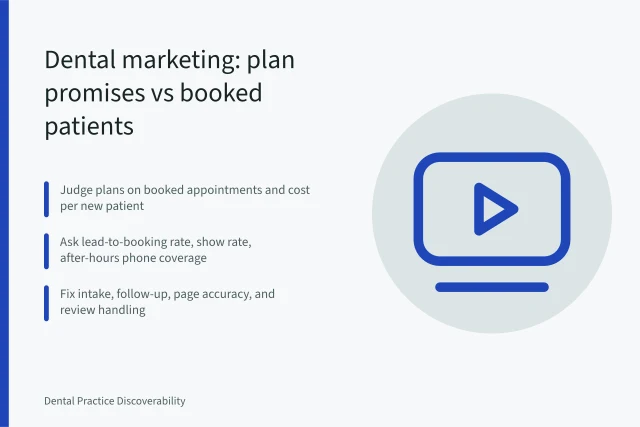
A plan can look correct on paper and still fail at the booking step. Track three signals: call answer rate, booking rate, and show rate. If call answer rate is low, ads waste money no matter how good the targeting is. If booking rate is low, the website or phone script needs work.
Three Signals to Track After Launch
- Call answer rateLow means ads waste money
- Booking rateLow means website or phone script needs work
- Show rateTracks whether booked patients arrive
A dental marketing plan is only as good as the appointment it creates and the patient who arrives.
Pay-per-click costs vary by market and service. Pay-per-click explains the bidding model and why a cheap click can still produce an expensive patient. Budget reviews should compare cost per booked visit, not cost per click alone.
Online reviews influence trust, but responses must avoid confirming that a reviewer is a patient. Online review covers platforms such as Google Reviews and the problem of fake reviews. A practice can request reviews without offering incentives that break platform rules.
The Telephone Consumer Protection Act provides statutory damages of $500 to $1,500 per violation for unwanted marketing calls or texts. Google's review policy prohibits review gating. The FTC Endorsement Guides require disclosure when reviews are incentivized. Delta Dental, Cigna, MetLife, Aetna, and UnitedHealthcare run provider directories with their own listing rules.
Insurance directories can send patients who do not match the practice's accepted plans. Keep directory profiles current to avoid wasted calls.