Reviews
Dental marketing strategy vs reality: the search terms patients actually use
Query reports show patients search by symptom, urgency, location, and price, not just procedure names. Learn to measure intent and cost per booked patient.
Dental marketing strategy vs reality: the search terms patients actually use
What to take away
- Patients search with symptoms, urgency, location, insurance, and price, not only procedure names.
- Google Search Console and Google Business Profile Insights show the actual queries that surface a practice.
- A page that ranks for the wrong intent can still lose the booking.
- Track calls, direction requests, booked appointments, and cost per new patient.
- Fix practice facts and service pages before increasing ad spend.
Assumed search language versus query reports
Most dental marketing strategy documents list procedures: veneers, implants, Invisalign, emergency dentist. Patients may use those terms, but query reports often show longer phrases. Examples include 'dentist open Saturday near me' or 'tooth pain after filling'. These phrases carry intent that a service page can answer.
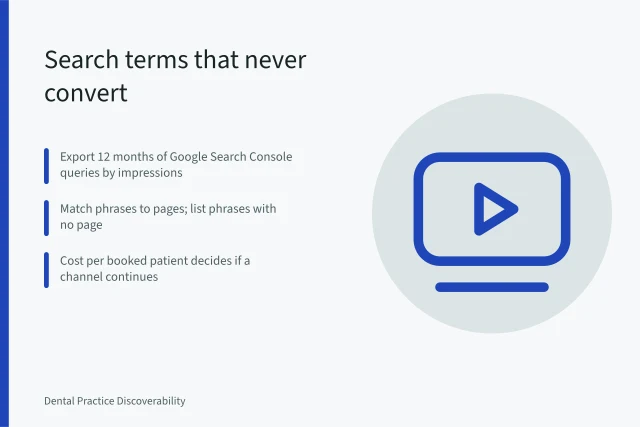
Google Search Console shows the queries that produced impressions and clicks. Google Business Profile Insights shows searches that led to calls, direction requests, and profile visits. Those two sources measure the gap between what a practice assumes and what patients type. For local visibility details, the Wikipedia entry on Google My Business explains how profiles surface in search and maps.
A practice that only tracks rankings may miss the queries that convert. A ranking for 'cosmetic dentist' does not help if the patient searches 'emergency toothache walk in'. Search intent decides whether a click becomes a booked appointment. For a side by side of channel tactics and booked outcomes, see dental marketing strategy.
Search terms patients actually use
Query patterns fall into several groups. Each group needs a clear answer on the site.
Patient Query Groups to Answer
- Symptomgum pain, jaw clicking, sensitive tooth
- Urgencyemergency dentist open now, same day extraction
- Locationdentist near me, walk in dentist
- Insurancetakes Delta Dental, Medicaid accepting patients
- Priceimplant cost, wisdom tooth removal price
- Agechildren's dentist, dentist for seniors
These phrases are not guesses. They appear in Search Console, Google Business Profile messages, and call logs. A practice can sort them by impressions, clicks, and calls. Google Trends can show seasonal shifts, such as searches rising during school breaks or open enrollment periods.
Metrics that separate strategy from results
Use a small set of numbers. Do not rely on impressions alone.
Metrics That Show Real Results
Metric
- Queries with impressions
- Search Console
- Calls and direction requests
- Business Profile
- Cost per new patient
- Ad platform and front desk
- Booked appointment rate
- Practice management system
- Review volume and rating
- Google reviews
Source
- Queries with impressions
- Actual patient language
- Calls and direction requests
- Local discovery to contact
- Cost per new patient
- Paid search payback
- Booked appointment rate
- Leads become patients
- Review volume and rating
- Trust signals affect clicks
What It Tells You
- Queries with impressions
- Calls and direction requests
- Cost per new patient
- Booked appointment rate
- Review volume and rating
Paid search cost models vary by market. The Wikipedia article on Google Ads covers cost per click and budget concepts. The key comparison is not cost per click but cost per booked patient. A low click price with no booking is more expensive than a higher click price that fills the schedule.
Common failures in dental marketing expectations vs results
A strategy can look complete on paper and still fail at the front desk.
Six Common Dental Marketing Failures
- Broad ads without negative keywords for jobs
- Service pages list features, not patient questions
- Location pages repeat text across suburbs
- Front desk does not log why callers do not book
- Review replies share private treatment details
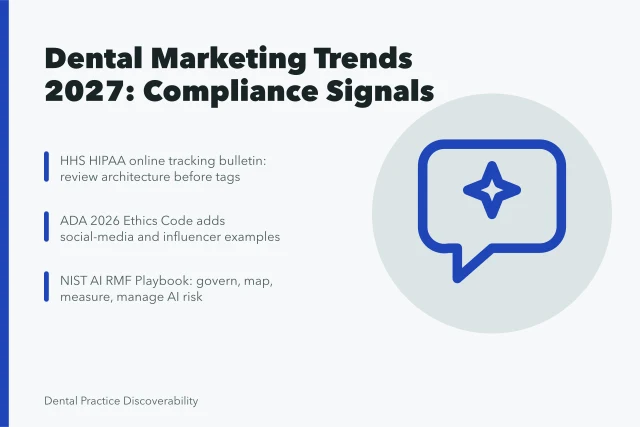
- Canada RCDSO and Competition Bureau; US HIPAA
For a full review of technical and content quality, see dental SEO in 2027. For the strategy side, compare planned tactics with booked appointment outcomes.
Example: a practice that ranked for the wrong intent
A practice spent on 'dental implants' and ranked on page one. The front desk log showed most calls asked about payment plans and consultation length. The implant page had no pricing range, no financing note, and no clear next step. After adding those details, the same traffic produced more booked consultations.
Implant Page Before and After
Before
- Page content
- No pricing range
- Financing
- No financing note
- Next step
- No clear next step
- Result
- Fewer booked consultations
After
- Page content
- Pricing range added
- Financing
- Financing note added
- Next step
- Clear next step added
- Result
- More booked consultations
That example is not about better rankings. It is about matching the page to the query intent. The query 'dental implant cost' needs a cost answer. The query 'dental implant procedure' needs a clinical explanation. The query 'implant dentist near me' needs location and hours. When one page tries to serve all three, patients leave.
Questions to ask before committing budget
- Which queries already bring impressions, calls, and direction requests?
- Which service pages answer the intent behind those queries?
- What is the current cost per new patient from each channel?
- Who reviews the front desk log and updates the pages?
- What will be measured in 30, 60, and 90 days?
A strategy is only as good as the query it answers.