Rules
Part of Dental SEO: signal versus noise, updated for 2027
How to improve dental SEO with a focused business plan, explained properly
how to improve dental SEO starts with verified facts, patient tasks, profiles, useful pages, technical testing, accessible journeys, and mature measures.
What to take away
- Correct the public facts and patient journey before expanding content.
- Give every page a distinct task, owner, and evidence source.
- Release small changes with baselines, tests, and rollback plans.
How to improve dental SEO begins with a focused business plan, not a list of ranking tactics. Choose one problem, such as wrong location information, a missing service explanation, or a broken mobile form. Name the patient task and business decision that the work should improve.
Fix profile ownership and facts
Google's Business Profile ownership guidelines say owners should understand and control their profiles, while authorized representatives should keep them informed and transfer ownership when requested. Keep the practice as owner and grant a vendor only the access its work needs.
Four-Week SEO Rollout
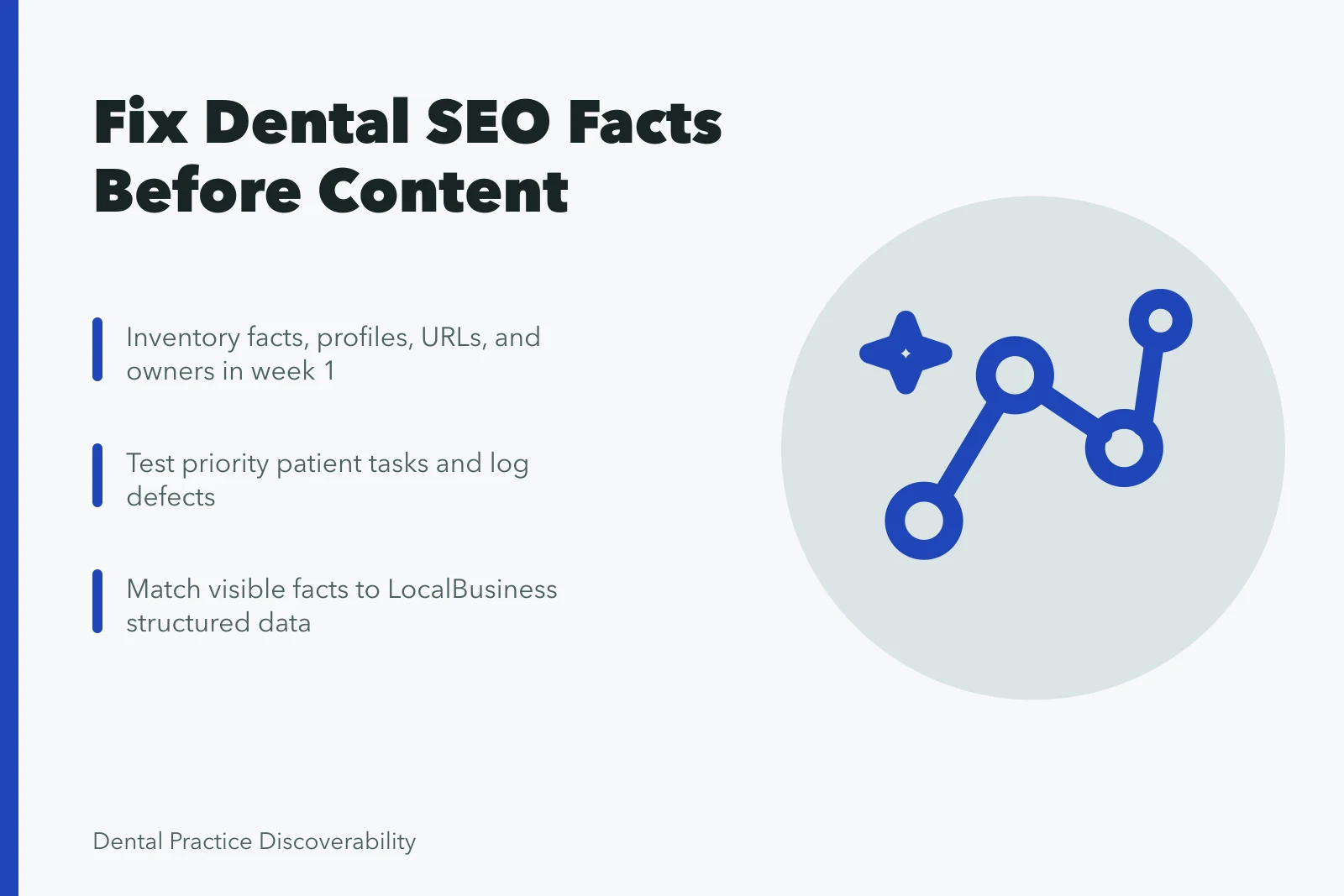
- Week 1Inventory facts, profiles, URLs, owners
- Week 2Test priority patient tasks
- Week 3Revise one page group
- Week 4Verify crawling, use, and calls
- Week 8+Review mature appointment cohort
| Week | Work | Evidence |
|---|---|---|
| 1 | Inventory facts, profiles, URLs, and owners | Source-of-truth register |
| 2 | Test priority patient tasks | Defect and access log |
| 3 | Revise one page group | Approved release record |
| 4 | Verify crawling, use, and calls | Technical and operational checks |
| 8+ | Review mature appointment cohort | Reconciled decision report |
Add factual local markup
Google's documentation for LocalBusiness structured data describes properties for details such as address, hours, departments, and business type, along with testing and deployment steps. Markup can support understanding but does not guarantee a search feature.
Local Markup Checklist
- One authoritative URL per location
- Match visible facts and markup
- Use direct local phone and current hours
- Explain services actually available there
- Test structured data and rendered output
- Check page again after deployment
Build one useful service page at a time. Interview staff and patients about the questions that block an appropriate next step. Have an accountable clinician review the explanation and a compliance reviewer assess public claims. Test with mobile and assistive technology users.
Map the pages a patient needs: one per service, insurance, new patients, and each location.
Example queries to answer: emergency dentist open now, does dental insurance cover a crown, new patient exam cost, dentist near me that takes Medicaid.
Use the patient's words in the title, the first sentence, and the heading.
Dental SEO work that pays first
- Correct the name, address, phone, hours, and category on Google Business Profile, Bing Places, and Apple Business Connect.
- Publish one page per high-value service, then insurance, new-patient, and location pages.
- Ask every treated patient for a review and reply to each one.
Then keep citations consistent across ADA Find-a-Dentist, your state dental association, Healthgrades, and Yelp. Post to the profile weekly or fortnightly with hours changes, new services, and accepted plans.
Track queries and indexing in Google Search Console, and calls, direction requests, and page-level sources in Google Business Profile and a call tracking number.
Measure the release through stages. Confirm crawl access and indexing, then review relevant impressions, clicks, successful contact actions, suitable appointments, and attendance. Note limited capacity, missed calls, duplicates, and incomplete source matching. Decide whether to keep, revise, or roll back the change.
Set a release checkpoint at 7 days for indexing and at 28 days for clicks, calls, and bookings. Compare against the 28 days before the change; those windows are typical, not fixed.
Log the decision and next review date.
Run a controlled handoff of dental SEO access
The GOV.UK technology selection guidance recommends adaptable choices, data control, security review, and ownership-cost analysis. Ask the same questions before you hand profile or analytics access to a named agency user you can revoke in one click.
The CISA software acquisition fact sheet covers development practice, supply-chain exposure, deployment, and vulnerability management. Its checklist fits anyone who edits your service pages.
Assign each step to a named role and require an observable finish condition. The analyst should reproduce the result, and the decision owner can explain the action and stop rule.
Include one broken-data case and one revoked-access case. Record the repair, the time required, and any vendor help, so the written process reflects normal operation, not a prepared demonstration.
Rejected options are recorded with the chosen path; the constraint that excluded them may not hold next quarter. When the decision cycle ends, close the reports and permissions nobody uses.
Common questions
What should be fixed first?
Fix inaccurate facts, inaccessible tasks, broken calls or forms, unsafe content, and technical blocks on important pages.
Should every location have identical content?
No. Shared facts can be templated, but each page should reflect its real clinicians, services, access, hours, and local context.
How long does local dental SEO take?
Typical ranges: 4 to 8 weeks for profile and technical fixes, 3 to 6 months for new service pages and reviews, 6 to 12 months in crowded markets.
When should new pages be added?
Add a page when a distinct patient task and maintainable body of verified information justify it.