Strategy
How Toronto dental practices compete for patient searches in a crowded market
Toronto dental practice patient searches are expensive: Google Ads clicks hit $12 to $25, so local SEO and smart agency pricing matter more than ever.
What to take away
- Toronto dental practice patient searches are among the priciest in Canada, with Google Ads cost per click for dental keywords often between $12 and $25 depending on procedure and competition.
- Local SEO tactics, including Google Business Profile optimization and review management, can lower your effective cost per new patient compared with paid search alone.
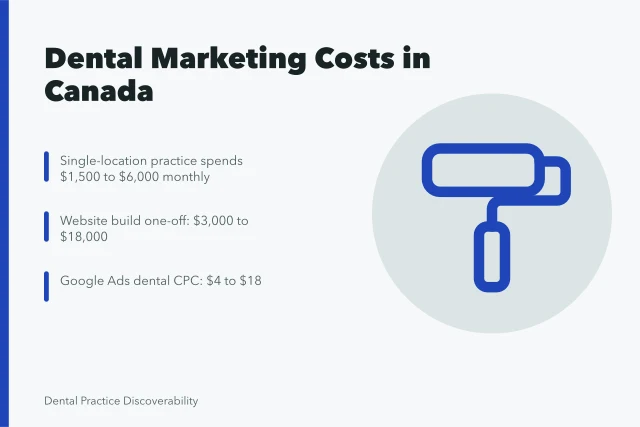
- Greater Toronto Area agency pricing varies widely: retainers commonly run from $1,500 to $6,000 per month, and you should know what each tier actually delivers.
- Toronto's dense, multicultural market and high business costs shape how you budget, from HST to Employer Health Tax.
- Track patient searches against spend monthly, using call tracking and booking data, not just impressions.
How crowded the Toronto dental search market is
Toronto has more dental practices per capita than any other Canadian city. The competition for patient searches is fierce, especially in midtown, downtown and along the subway lines. Walk down Yonge Street and you will pass a dozen clinics in a few blocks.
That density means your Google Business Profile competes with hundreds of others in the same radius. When someone searches "dentist near me" in Toronto, Google shows a local pack of three results. Getting into that pack is the difference between a full schedule and an empty one.
The city's business environment adds pressure. Business Operation & Growth resources from the City of Toronto note one of the highest concentrations of small businesses in North America, and dental offices are no exception. You are not just competing with other dentists; you are competing for attention in a crowded digital space.
Population growth in the Greater Toronto Area (GTA) keeps demand high, but it also attracts new practices. According to Statistics Canada's census data, the GTA added hundreds of thousands of residents in the last decade, many of them settling in suburbs like Mississauga, Brampton and Markham. Those areas are now seeing their own dental booms.
For practice owners, the takeaway is simple: you cannot rely on word of mouth alone. You need to be visible where patients search, and that means investing in both paid and organic channels.
Google Ads cost per click for Toronto dental keywords
Google Ads cost per click for dental keywords in Toronto is higher than in most Canadian cities. The exact amount varies by procedure, but general dentistry terms like "teeth cleaning" might cost $8 to $15 per click, while cosmetic terms like "dental implants" can exceed $25.
Why so high? Because dental services are high value. A single implant patient can be worth thousands of dollars, so practices are willing to bid aggressively. The auction is also crowded with dental marketing agencies bidding on behalf of multiple clients.
Here is a rough table of typical cost per click ranges for Toronto dental keywords. These are estimates based on industry benchmarks and may vary by campaign quality and time of year.
Show the numbers
| General dentistry | $10–$18 |
|---|---|
| Emergency dentistry | $15–$25 |
| Cosmetic dentistry | $8–$15 |
| Orthodontics | $12–$22 |
| Implants | $18–$30 |
These figures are not set in stone. Your actual cost depends on your quality score, ad relevance, and landing page experience. A well-optimized campaign can pay less per click than a poorly managed one.
If you want a deeper breakdown of what a realistic budget looks like, see our guide on the cost of google ads for dentists. It covers monthly spend scenarios and how to allocate budget across services.
Remember that Google Ads is an auction. During peak times, like January when people use up insurance benefits, costs can spike. You need to monitor and adjust bids accordingly.
Local SEO tactics for Toronto dental practices
Local SEO is your best bet for sustainable patient searches. Unlike ads, where you pay for every click, organic visibility builds over time and can deliver patients at a lower cost per acquisition.
The first step is to claim and optimize your Google Business Profile. Fill out every field, choose the right categories, and add high-quality photos of your office and team. Post updates regularly, such as new services or health tips. This signals to Google that your profile is active.
Reviews are critical. Toronto patients often choose a dentist based on star rating and recency of reviews. Ask happy patients to leave a review on Google, and respond to all reviews, positive or negative. A steady stream of reviews can push you into the local pack.
Next, build local citations. Ensure your name, address, and phone number (NAP) are consistent across directories like Yellow Pages, Yelp, and provincial dental college listings. Inconsistent NAP confuses Google and hurts your rankings.
Create location-specific pages on your website if you serve multiple areas in the GTA. For example, a page for "dentist in Etobicoke" should have unique content about that neighbourhood, not just a swapped city name. This is where many practices fail; they use generic templates that Google ignores.
For a step-by-step guide on ranking in the map pack, read our article on how to Rank in Google Maps. It explains the factors that influence local rankings and how to improve them without paid ads.
Finally, consider your website's mobile experience. Most local searches happen on smartphones. If your site is slow or hard to use on mobile, patients will bounce and choose another practice.
Greater Toronto Area agency pricing and what it buys
Dental marketing agencies in the GTA charge a wide range of fees. Some solo consultants might charge $1,000 per month for basic SEO, while full-service agencies can charge $10,000 or more for comprehensive campaigns including web design, content, and paid ads.
Typical retainers fall into three tiers. Entry-level, around $1,500 to $2,500 per month, usually covers Google Business Profile management, a few blog posts, and basic reporting. Mid-tier, $2,500 to $5,000, adds on-page SEO, link building, and ad management. Premium, $5,000 to $10,000+, includes video production, reputation management, and conversion rate optimization.
What should you get for your money? At a minimum, you want transparency. Ask for access to your Google Ads account and analytics. You should own your data. Also, check if the agency has experience with dental regulations in Ontario, such as advertising rules from the Royal College of Dental Surgeons of Ontario.
Be wary of agencies that promise first-page rankings. No one can guarantee that. Instead, look for case studies with local Toronto practices and verifiable results. If you are comparing agencies, our article on how to remove false google review dental practice outlines the questions to ask during an interview.
Remember that agency fees are subject to HST in Ontario. The Harmonized Sales Tax adds 13% to most marketing services, so budget accordingly. Your total cost of dental marketing canada will include this tax, along with any software subscriptions or ad spend.
Toronto business context for practice growth
Running a dental practice in Toronto means dealing with specific cost structures. The Employer Health Tax applies to Ontario employers with payroll over $1 million, which many multi-doctor practices exceed. This is an additional cost that affects your bottom line and marketing budget.
Commercial rent in Toronto is among the highest in Canada, especially in prime locations. That fixed cost means you need a steady flow of patients to break even. Marketing is not a luxury; it is a necessity to fill chairs.
The patient base is diverse. Toronto is one of the most multicultural cities in the world, with large communities speaking Mandarin, Cantonese, Punjabi, Tagalog, and many other languages. Your marketing should reflect that diversity, perhaps with multilingual website content or targeted ads.
Competition comes not only from other private practices but also from corporate dental chains and the Canadian Dental Care Plan (CDCP). The CDCP, which rolled out nationally, provides coverage for eligible Canadians. This may increase demand for services, but it also means more patients are price-sensitive. You need to communicate value.
For local service context, 311 Toronto is the city's non-emergency service line. While not directly related to dental marketing, it is a reminder that Toronto residents expect easy access to information. Your practice should offer the same online.
When planning your practice marketing budget, factor in these local costs. A marketing budget that works in a smaller city may not suffice in Toronto.
Measuring patient searches against spend in Toronto
You cannot manage what you do not measure. Track the number of patient searches that lead to appointments, not just website visits. Use call tracking numbers to see which channels generate phone calls. Set up conversion tracking in Google Ads and Google Analytics to monitor form submissions and bookings.
Calculate your cost per new patient. If you spend $3,000 on Google Ads and get 10 new patients, your cost per acquisition is $300. Compare that to your average patient lifetime value. If a patient is worth $2,000 over several years, then $300 is a good investment.
Segment your data by neighbourhood. Patients from different parts of the GTA may respond to different messages. For example, a downtown professional might care about convenience and evening hours, while a family in Scarborough might prioritize affordability and weekend availability.
Review your spend monthly. Look at which keywords convert and which waste money. Pause underperforming ads and double down on what works. Use negative keywords to filter out irrelevant searches, like "free dental" or "dental school."
A Toronto practice spends $2,500 per month on Google Ads and $1,500 on SEO. They get 15 new patients from ads and 10 from organic. Their total marketing spend is $4,000, and they acquire 25 patients, for a blended cost per patient of $160.
If the average patient brings in $800 in the first year, the return is strong.
Remember that SEO takes time. You may not see results for three to six months. But once you rank, the traffic is essentially free. Balance short-term paid campaigns with long-term organic growth.
Finally, stay compliant with Canadian privacy laws. PIPEDA and Ontario's PHIPA govern how you collect and use patient data. Ensure your marketing consent practices are clear and documented.
Common questions
How much should I budget for Google Ads in Toronto? A minimum of $1,500 to $2,000 per month is realistic for a small practice targeting a few key services. Larger practices with multiple locations may need $5,000 or more to compete effectively.
Do I need a local SEO agency in Toronto? Not necessarily. If you have time and some technical skill, you can manage your Google Business Profile and local citations yourself. But an agency can save time and bring expertise, especially for competitive keywords.
What is the biggest mistake Toronto dentists make with marketing? Using generic content that does not reflect Toronto's neighbourhoods or patient demographics. Google rewards local relevance, and patients notice when a practice speaks to their community.
How does the Canadian Dental Care Plan affect my marketing? The CDCP may bring in new patients who previously could not afford care. Highlight your participation and make it easy for patients to check eligibility on your website.
Are there regulations for dental advertising in Ontario? Yes. The Royal College of Dental Surgeons of Ontario has guidelines on advertising, including prohibitions on misleading claims. Review them before launching any campaign.
How long before SEO shows results in Toronto? Typically three to six months for noticeable improvements, and up to a year for competitive terms. Paid ads deliver immediate traffic but stop when you stop paying.