Strategy
Rural and remote dental practice discoverability across Northern Canada
Northern Canada dental practice discoverability depends on listings, referrals and sites that work on slow satellite links across Yukon, NWT and Nunavut.
What to take away
- Northern Canada dental practice discoverability runs on three things: accurate listings, community referral routes and pages light enough for satellite internet.
- Yukon, Northwest Territories and Nunavut each have their own health system, so a single territorial landing page will not carry a practice across all three.
- Satellite internet limits mean heavy booking widgets, autoplay video and large image galleries fail exactly where patients need them most.
- Community referral routes, from health centres to band offices to flight schedulers, often bring in more patients than a search ranking does.
- The Index of Remoteness and Proximity Measures Database tell you which communities you can realistically serve, and which need a travel or fly-in plan.
- Dental offices in these territories also answer to PIPEDA, CASL and their territorial privacy rules, not to HIPAA.
Why Northern Canada dental discoverability differs from southern markets
A dental practice in Whitehorse or Yellowknife is not competing with fifty other clinics on one street. It is competing with distance, weather and a small pool of people who search at all. That changes what discoverability means.
In southern Ontario or British Columbia, a clinic can rank for "dentist near me" and expect a steady flow of local searches. In Northern Canada, the search volume for any single procedure term in a single community can be a handful of queries a month. A page built for that volume still has to earn its place.
The population is small and spread out. The Index of Remoteness scores communities on how far they sit from population centres, and much of the North scores high. A practice in Yellowknife may serve patients from communities hundreds of kilometres away, some reachable only by air or winter road.
That reach cuts both ways. Fewer competitors means easier rankings, but the patients you reach may never walk in without a referral, a travel plan or a flight. Marketing has to answer the practical question first: how does someone from a small community actually get to your chair?
Territorial health systems also shape demand. The Yukon, Northwest Territories and Nunavut each run public dental programmes for children and for eligible adults, and the federal Canadian Dental Care Plan now covers many more. A practice that explains how those programmes interact with its own fees saves every new patient a phone call.
Housing conditions shape the work as much as the search does. The Northern Housing Report | CMHC describes crowding and housing stress across northern communities, which affects where a visiting team stays and how patients arrange travel.
Language and literacy matter too. Plain wording, large text and phone numbers that work from a landline beat a sleek form that assumes fast data.
If your site was designed for a southern city, it probably assumes things that are not true here. Understanding the cost of dental marketing canada practices actually pay helps you budget for a rebuild that fits.
Yukon, Northwest Territories and Nunavut search and listing basics
Start with the map pack. Most northern searches for a dentist happen on a phone, and Google Business Profile is where those searches land. Claim the profile, pick the right primary category, and keep hours accurate through the dark months when travel is harder.
Each territory needs its own content. Yukon health services, Northwest Territories health services and Nunavut health services are separate systems with separate referral paths and separate public dental programmes. A page that says "the North" and lists nothing specific helps nobody.
Listings beyond Google matter here. Territorial health directories, band and hamlet office listings, airline and medevac contacts, and community Facebook groups all feed discovery. The Open Database of Addresses is a useful public reference for verifying community names and address formats before you publish them.
Naming is a trap. Communities carry official names and older names, and patients search both. A Nunavut dental patients page that only uses the official spelling will miss people who type the name they grew up with. Include the variants in body text, not in a keyword-stuffed title.
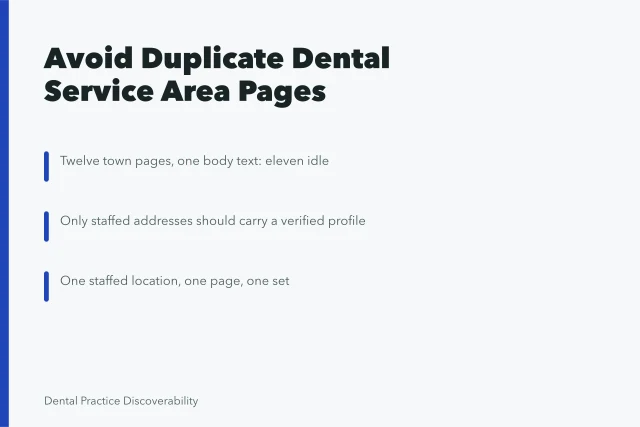
Keep one page per community you genuinely serve, with real content about travel, lodging, escorts and billing. If you run several locations, Service Area Pages need distinct details, not a swapped place name. Duplicate pages across Yukon, Northwest Territories and Nunavut will compete with each other and rank poorly.
Reviews are thin in small communities, so a handful carries weight. Ask patients after a completed treatment, not by mass email. Under Canada's Anti-Spam Legislation, commercial electronic messages need consent, a sender identity and an unsubscribe route.
| Territory | Main search behaviour | Listing priority | Referral route |
|---|---|---|---|
| Yukon | Whitehorse-centred, some highway communities | Google Business Profile, territorial health directory | Health centres, Yukon hospitals, travel support |
| Northwest Territories | Yellowknife plus fly-in communities | Google Business Profile, band and hamlet offices | Health centres, medevac and scheduled flights |
| Nunavut | Community-level searches, low volume | Google Business Profile, hamlet offices, Facebook groups | Health centres, public dental clinics, flight schedules |
Satellite internet limits for dental websites and booking tools
Satellite internet limits are the single most overlooked constraint on northern dental websites. Many households and health centres rely on satellite or fixed wireless links with high latency, capped monthly data and speeds that drop in bad weather.
High latency breaks the things southern web designers love. Live chat windows, third-party booking widgets that load scripts from four domains, and map embeds all stall. A patient on a capped connection may abandon the page before the booking button appears.
Keep pages light. Compress images, drop autoplay video, and avoid fonts and scripts loaded from outside your domain. A simple phone number and a short form will outperform a full scheduling system in most northern communities.
Booking needs a fallback. Offer a phone number that a health centre can call on your behalf, and state your hours in local time. If you use an online booking tool, test it on a throttled connection before you promote it.
Accessibility overlaps with bandwidth. Large text, high contrast and short paragraphs help older patients and anyone reading on a small screen. The same choices that make a page fast make it usable.
Run through a plan for your dental practice marketing budget with a slow connection in mind, and treat page weight as a clinical access issue, not a design preference. If a page cannot load in a health centre, it cannot recruit a patient.
Community referral routes and health service mapping
Community referral routes carry more weight in the North than any ranking. Health centres, nursing stations, community health representatives and band or hamlet offices are the front door for most patients who need care outside their community.
Build relationships before you build pages. Send plain-language referral information to each health centre in your catchment, with your hours, accepted programmes, travel expectations and who to call for an appointment.
The Open Database of Healthcare Facilities lists health facilities across Canada and is a practical starting point for mapping which communities have a clinic, a nursing station or nothing at all. That map tells you where referrals can originate.
Flight and travel logistics belong on your site. State whether patients need an escort, how long a visit takes, where they can stay and how billing works. A patient deciding whether to fly to Yellowknife or Whitehorse needs those answers before they call.
Public programmes are part of the referral conversation. Non-insured health benefits for First Nations and Inuit patients, territorial children's dental programmes and the Canadian Dental Care Plan all affect who pays. Explain the sequence clearly so no one arrives unprepared.
Track where patients come from. A simple question at reception, "who sent you or how did you hear about us", gives you referral data that no analytics platform will capture. Use it to decide which relationships to invest in next.
Index of Remoteness and proximity data for dental service access
The Index of Remoteness gives you a defensible way to talk about distance. It scores communities on population size and the distance to the nearest population centre, which is exactly the problem a northern dental practice solves.
Use it to sort your catchment. Communities with high remoteness scores need travel support, fly-in clinics or partnerships with territorial health services. Communities with lower scores can be served by ordinary outreach and a good listing.
The Proximity Measures Database adds the service side. It records how close communities are to various services, including health care, which helps you decide where a visiting clinic or a satellite day makes sense.
Neither dataset tells you where to advertise. They tell you where the need is, and where your current model cannot reach. Pair them with your own appointment data to see which communities already send patients and which never do.
Housing and workforce context matter for planning. The Northern Housing Report describes crowding and housing conditions in northern communities, which affect everything from recruitment of staff to where a visiting team can stay.
When you write about access on your site, use this data honestly. Saying a community is remote is not a marketing line, it is a statement about how far someone must travel for a filling. Patients recognise the difference.
Digital strategies that work for rural and remote dental practices
Build the foundation first, then the outreach. A practice with an accurate profile, light pages and clear referral information will out-recruit one with a bigger ad budget and a slow site.
- Claim and complete your Google Business Profile, with accurate hours, service categories, phone number and photos of the actual clinic. Learn how to Rank in Google Maps for the searches that happen inside your own community.
- Publish one page per community you serve, with travel details, programmes accepted and a local phone contact. Keep each page distinct enough that it earns its own place in search.
- Compress every page until it loads on a throttled connection, and remove any booking script that stalls. Test on a phone, on mobile data, from outside the clinic.
- Map your referral routes and contact each health centre, band office and hamlet office with a one-page referral sheet. Repeat the contact each season.
- Use the Index of Remoteness and Proximity Measures Database to decide where to run visiting clinics or outreach days, and say so on your site.
- Track referral sources at reception and review the numbers quarterly. Cut what brings nobody and double what brings patients.
Worked example: a Yellowknife practice reaching a fly-in community
A two-dentist practice in Yellowknife wants patients from a community 400 kilometres away with a nursing station and no resident dentist. The team checks the Index of Remoteness and finds the community scores high, then confirms through the Proximity Measures Database that dental care sits far away.
The practice builds a single page for that community. It lists the flight schedule, the nursing station phone number, the escort policy, which public programmes apply and how billing works. The page uses compressed images and no third-party booking widget.
The dentist calls the nursing station and sends a referral sheet. The health centre now knows who to call. Within a season, the practice has a small but steady flow of patients from that community, plus a referral relationship that keeps producing.
That is the northern pattern: one community, one page, one relationship at a time. A hipaa compliant dental marketing approach helps you keep the sequence straight when you repeat it.
Common questions
Do I need separate pages for Yukon, Northwest Territories and Nunavut? Yes, if you serve patients in more than one territory. Each has its own health system, public dental programmes and referral routes, so the content differs in substance, not just in place name.
How do satellite internet limits change dental website design? They make weight and latency the deciding factors. Pages that load quickly on a capped, high-latency connection keep patients, while booking widgets and autoplay video lose them.
What are the main community referral routes in the North? Health centres, nursing stations, community health representatives, band and hamlet offices, and territorial health services. A referral sheet and a phone call do more than most ads.
Which Canadian privacy and marketing laws apply to northern dental practices? PIPEDA governs personal information held by private practices, CASL governs commercial electronic messages, and territorial health privacy rules apply to patient records. HIPAA does not apply in Canada.
How do I decide which remote communities to target? Use the Index of Remoteness and Proximity Measures Database to find communities with high remoteness and distant dental services, then check whether your travel and staffing model can actually serve them.
Can a small northern practice compete with larger southern clinics online? Usually yes, within its own catchment. Search volume is low and local competition is thin, so accurate listings, light pages and real referral relationships decide most of the outcome.